I’ve been in this industry long enough to know when a shift is coming.
This one isn’t coming. It’s already here.
The agencies that built their business on doing things for clients are watching AI take on more of the execution work that once required significant human time. And many agencies are now being forced to rethink where they create value.
Let me be direct about what’s unfolding.
The Services Under Pressure
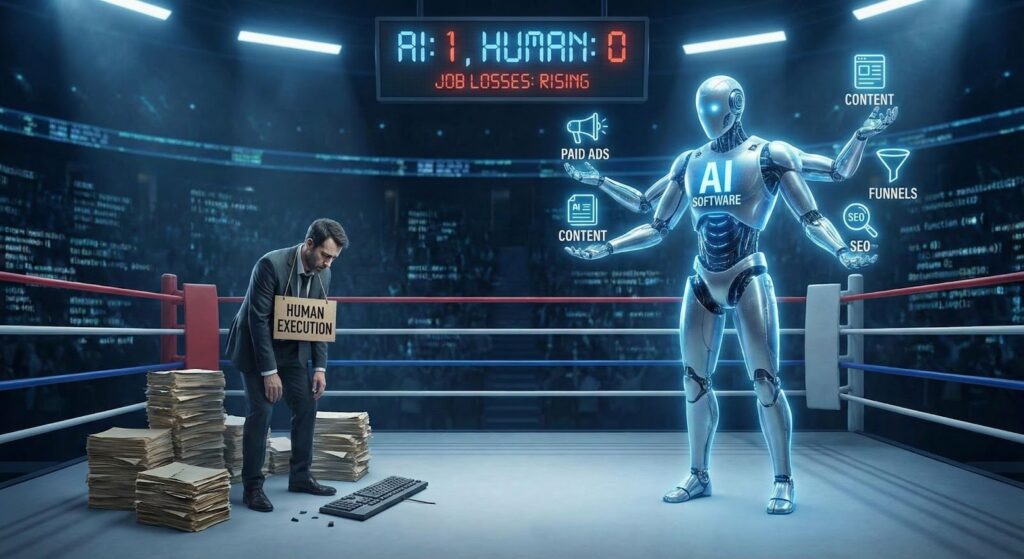
AI is changing execution work. Not in five years. Now.
Running paid ads. Writing content. Building funnels. Setting up automations. Managing social media. Basic SEO. Reporting. Chatbot setup.
Many of these services are becoming faster and easier to deliver with AI and automation.
AI tools can now assist with code, content, analysis, automation, media, SEO, and other tasks that previously required considerably more manual work. Clients are seeing these changes too.
Forrester forecasts a 15% reduction in agency jobs in 2026, following an average 8% headcount cut in 2025, as AI and automation reshape agency operating models. One unnamed global holding-company CEO quoted by Forrester put the direction bluntly: “By 2028, we’ll double profits and halve the people.”
If you’re selling execution alone, you’re increasingly competing with software-assisted alternatives. That’s changing the value equation for agencies.
Three Forces Reshaping the Market
AI development is moving quickly.
AI adoption across agencies is already widespread. According to Forrester’s 2026 research with 4As, nine in 10 US marketing agencies use generative AI, while half use agentic AI for marketing execution.
Work that once required significant manual effort can increasingly be accelerated with AI. Clients are becoming more aware of these capabilities and may question how agency pricing should change as delivery becomes more efficient.
Customer expectations continue to evolve.
Fast responses. Convenient experiences. Greater personalisation. Businesses increasingly need to consider how effectively their websites and customer-facing systems respond to these expectations.
Results are becoming increasingly important.
Impressions and reach can still be useful marketing indicators. But clients ultimately care about business outcomes. Agencies that can connect their work more clearly to leads, conversations, sales, and revenue can make their value easier to understand.

What Clients Will Actually Pay For
The opportunity is increasingly moving toward five areas:
Strategy that fits their specific situation. AI can assist with execution. Humans bring judgment, context, and strategic thinking. Businesses still need people who understand their market, customers, competitive position, and goals.
Unified AI systems. Not 15 disconnected tools held together with duct tape. Businesses can benefit from an intelligent system that watches, qualifies, engages, and knows when to bring in a human. Agencies that can implement and manage these systems can create additional value for clients.
AI for qualification. Humans for closing. Let AI help with watching, engaging, and filtering. Save human time for complex sales, high-value conversations, and moments where personal interaction and trust matter.
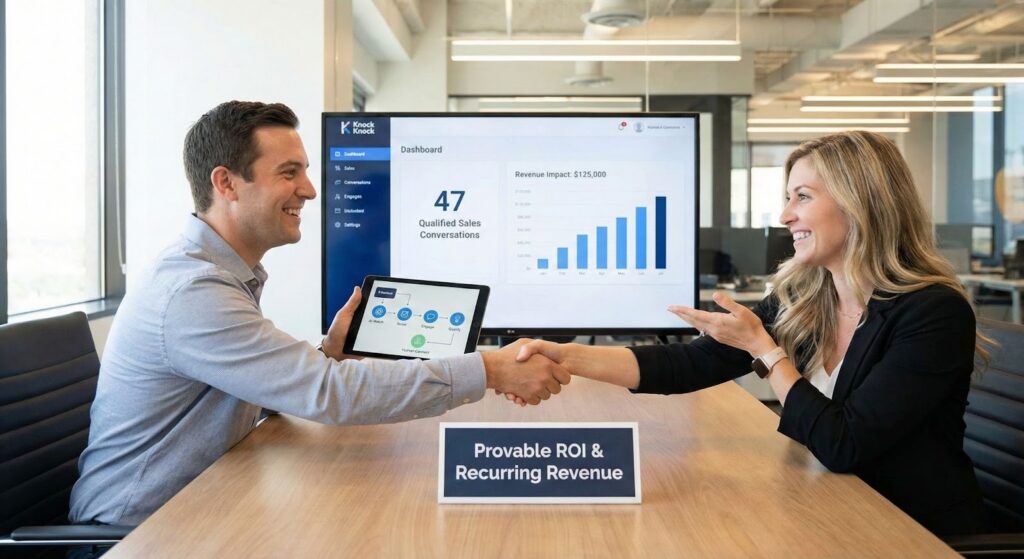
Accountability for real outcomes. Not just “we delivered impressions.” Instead, agencies can provide visibility into qualified conversations, opportunities, conversions, and other measurable business outcomes.
Trust when it matters. For many high-consideration decisions, people still value human interaction. AI can support the journey while people handle conversations where judgment, reassurance, and personal connection matter.

The Gap Most Agencies Miss
Here’s what I see constantly.
Agencies spend heavily on driving traffic. Then they hand over leads and depend on the client’s sales team to follow up. When conversions are weak, questions often arise about lead quality and marketing performance.
But there can be another problem: nobody engaged the visitor while their interest was high.
A prospect on your client’s website at 9pm may be showing intent. If no one engages them at that moment, the opportunity may cool or disappear.
This is the gap. And it’s an area where the future agency can create additional value.

The Model That Wins
One emerging model is to own more of the journey. Not just traffic. Conversion.
AI can monitor visitor behaviour. Score intent in real time. Engage at the right moment. Support qualification. And when someone needs a real conversation, connects them to a human instantly.
That’s what we built Knock Knock to support.
Instead of saying only, “we got you 500 clicks,” agencies can show clients the sales conversations, qualified opportunities, and conversion activity generated from that traffic.
That’s a clearer connection between marketing activity and business outcomes. And it gives agencies another way to demonstrate ongoing value.
Where This Lands
The agency of 2030 may be smaller. Smarter. More technology-enabled. And more focused on the moments that actually influence business outcomes.
AI handles more of what AI can handle efficiently. Humans show up where judgment, expertise, creativity, and personal interaction matter.
The shift isn’t coming. It’s already underway. The question is how agencies reshape their business models around it as the technology continues to evolve.
I know which kind of agency we’re building Knock Knock to support.

Anna Hyatt
Co-Founder | Knock Knock App
AI × Human Touch = Happier Clients, More Revenue
LinkedIn Profile