The Data Is In. The Debate Is Over.
Does live chat actually work?
Some marketers swear by it. Others call it overrated. Everyone has opinions.
But opinions aren’t data.
So I went looking for data. Real studies. Published research. Numbers from companies that measured before and after.
Here’s what I found: Live chat works. But not the way most people implement it.
The studies prove both. Let me show you.
Study #1: The Speed-to-Lead Research
Source: InsideSales.com / Harvard Business Review Finding: The first company to respond wins 78% of deals.
This study analyzed over 100,000 call attempts across multiple industries. The conclusion was devastating for slow responders.
If you respond to a lead within 5 minutes, you’re 21x more likely to qualify them than if you wait 30 minutes.
Wait an hour? Your odds drop by 10x.
Wait a day? You’ve basically lost.
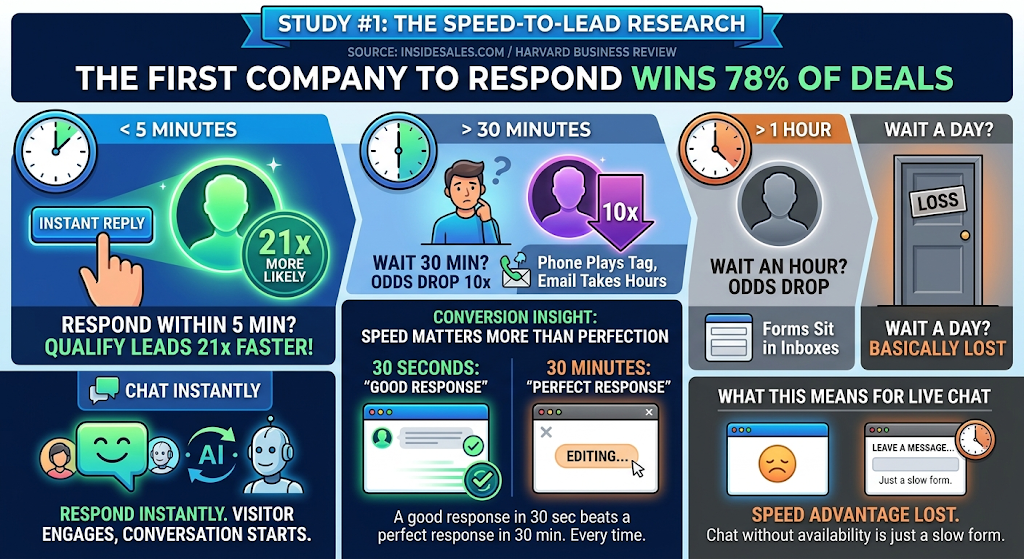
What this means for live chat:
Live chat is the fastest possible response channel. Visitor lands, AI engages, conversation starts — all within seconds.
Email takes hours. Phone plays tag. Forms sit in inboxes. Chat responds instantly.
But here’s the catch: if your chat says “Leave a message and we’ll get back to you,” you’ve lost the speed advantage. The study proves speed wins. Chat without availability is just a slow form.
The conversion insight:
Speed matters more than perfection. A good response in 30 seconds beats a perfect response in 30 minutes. Every time.
Study #2: The Forrester ROI Analysis
Source: Forrester Research Finding: Live chat delivers $6 in ROI for every $1 spent.
Forrester studied businesses across industries implementing live chat. The return wasn’t marginal — it was substantial.
For every dollar invested in live chat, businesses saw six dollars in return.
Where did the ROI come from?
- Higher conversion rates (leads that would have left, converted instead)
- Larger deal sizes (chat agents could upsell in real-time)
- Reduced support costs (one agent handles multiple chats vs. one phone call)
- Increased customer satisfaction (faster answers, less friction)
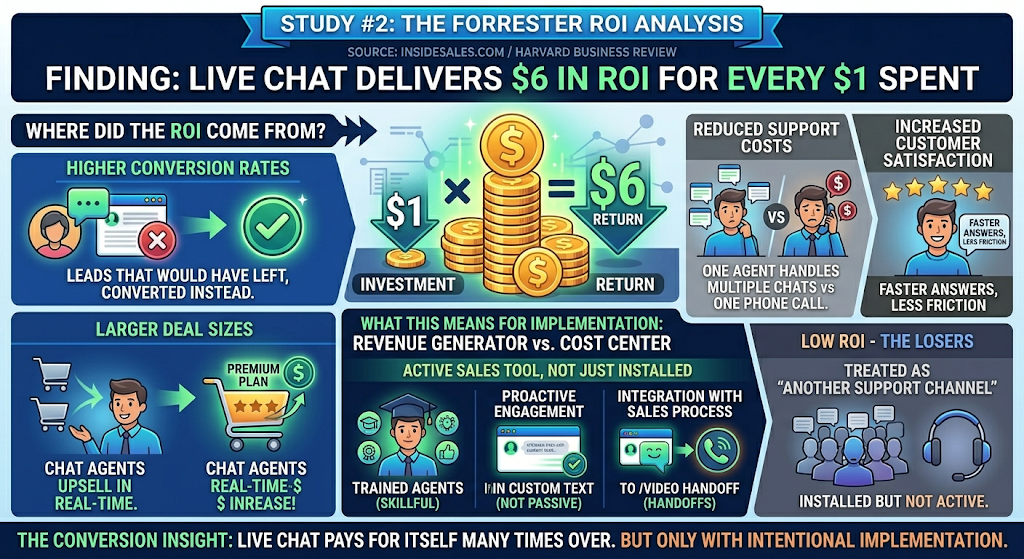
What this means for implementation:
Live chat isn’t a cost center. It’s a revenue generator. But only if it’s actively used — not just installed.
Companies that saw the highest ROI had:
- Trained agents (not just warm bodies)
- Proactive engagement (not waiting for visitors to start)
- Integration with sales process (chat-to-call handoffs)
Companies that saw low ROI treated chat as “another support channel.” The winners treated it as a sales conversion tool.
The conversion insight:
Live chat pays for itself many times over. But only with intentional implementation.
Study #3: The Ecommerce Conversion Study
Source: Forrester / eMarketer Finding: Customers who use live chat are 2.8x more likely to convert than those who don’t.
This study tracked purchase behavior across e-commerce sites. The gap between chatters and non-chatters was stark.
Visitors who engaged with live chat converted at 2.8x the rate of visitors who browsed silently.
Even more interesting: chat users spent 60% more per order on average.
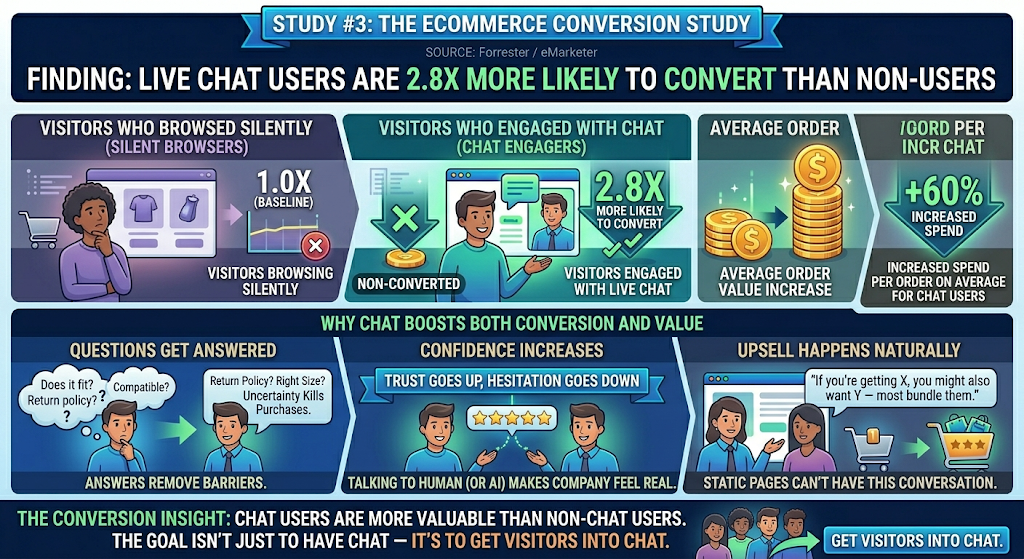
Why does chat increase both conversion AND order value?
Three reasons:
- Questions get answered. Uncertainty kills purchases. “Does this work with X?” “What’s the return policy?” “Is this the right size?” Answers remove barriers.
- Confidence increases. Talking to a human (or a smart AI) makes the company feel real. Trust goes up. Hesitation goes down.
- Upsell happens naturally. “If you’re getting X, you might also want Y — most customers bundle them.” That conversation can’t happen with a static page.
The conversion insight:
Chat users are more valuable than non-chat users. The goal isn’t just to have chat — it’s to get visitors INTO chat.
Study #4: The Proactive vs Reactive Study
Source: Zoho / Various Industry Studies Finding: Proactive chat increases engagement by 3-5x over reactive chat.
Reactive chat waits. The visitor has to click, has to initiate, has to ask.
Proactive chat reaches out. The system identifies the right moment and starts the conversation.
The difference in engagement is massive.
- Reactive chat engagement: 2-4%
- Proactive chat engagement: 10-15%
That’s not a small improvement. That’s a different strategy entirely.
But there’s a caveat:
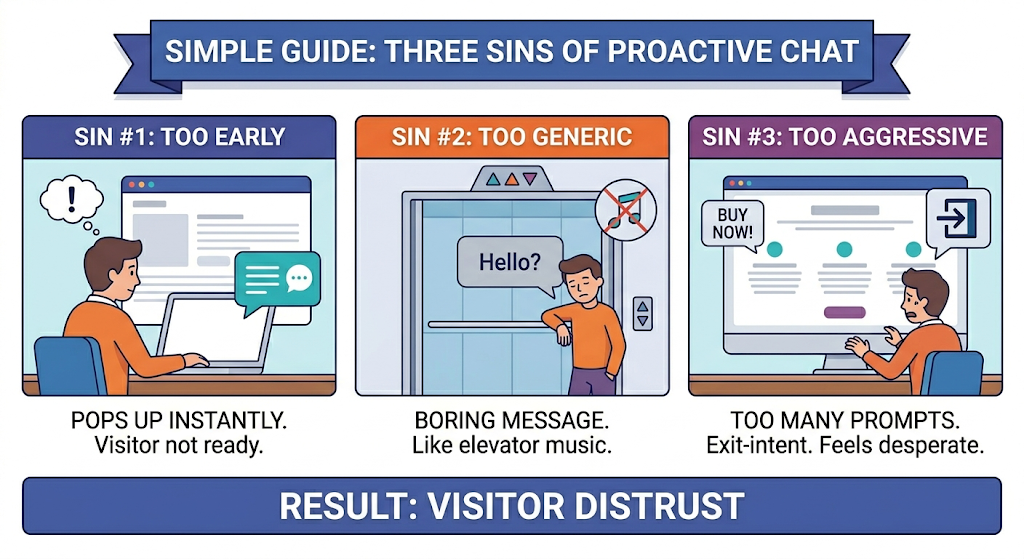
Proactive chat only works when it’s contextual. Generic “Hi! How can I help?” pop-ups perform worse than reactive chat. Visitors ignore them or find them annoying.
Contextual proactive chat — “I see you’re comparing plans, want help choosing?” — dramatically outperforms everything else.
The conversion insight:
Proactive engagement multiplies results. But only with context.
Study #5: The Customer Satisfaction Research
Source: Zendesk Customer Experience Trends Report Finding: Live chat has the highest customer satisfaction rate (92%) of any support channel.
Zendesk analyzed satisfaction across channels. The hierarchy was clear:
| Channel | Satisfaction Rate |
| Live Chat | 92% |
| Phone | 88% |
| 85% | |
| Social Media | 84% |
| Web Forms | 80% |
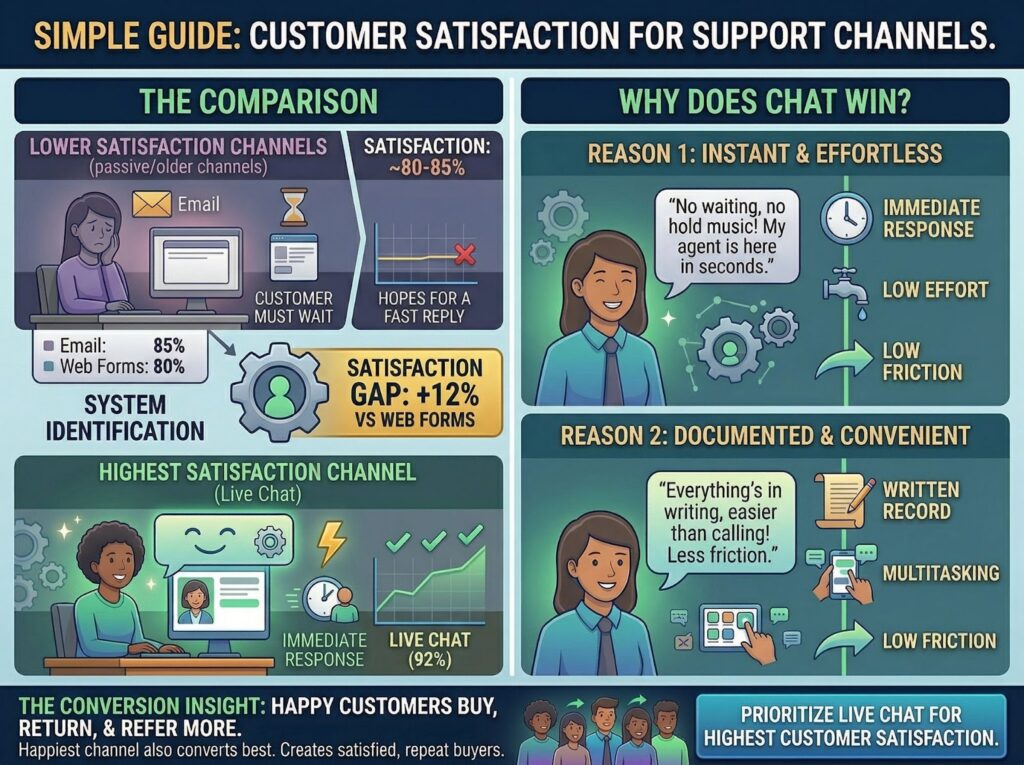
Why does chat win?
- Immediate response — No hold music, no waiting for callbacks
- Multitasking — Customers can chat while doing other things
- Written record — Everything documented, no “he said she said”
- Low effort — Easier than calling, faster than email
What this means for conversion:
Happy customers buy more. They return more. They refer more.
The channel that makes them happiest also converts them best. Not a coincidence.
The conversion insight:
Chat doesn’t just convert first-time buyers. It creates satisfied customers who become repeat buyers.
Study #6: The B2B Buyer Research
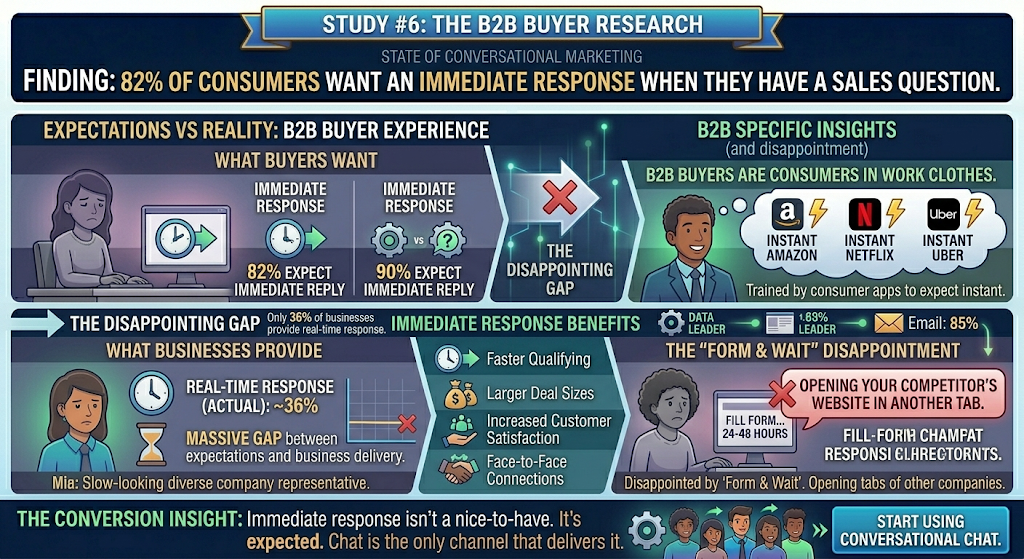
Source: Drift State of Conversational Marketing Finding: 82% of consumers want an immediate response when they have a sales question.
Drift surveyed buyers about their expectations. The results were overwhelming:
- 82% expect immediate response on sales questions
- 90% expect immediate response on support questions
- Only 36% of businesses actually provide real-time response
There’s a massive gap between what buyers want and what businesses provide.
The companies that close this gap win. The companies that don’t, lose to those who do.
The B2B specific insight:
B2B buyers are just consumers in work clothes. They’ve been trained by Amazon, Netflix, and Uber to expect instant.
When they hit your website and get “Fill out this form and someone will call you in 24-48 hours,” they’re disappointed. They might comply. But they’re also opening your competitor’s website in another tab.
The conversion insight:
Immediate response isn’t a nice-to-have. It’s expected. Chat is the only channel that delivers it.
Study #7: The Intent + Identification Study
Source: Gartner / LeadForensics Industry Data Finding: Identified visitors convert 5-10x higher than anonymous visitors.
This research looked at what happens when you know who’s visiting versus when you don’t.
Anonymous visitor conversion rate: 1-2% Identified visitor conversion rate: 5-15%
Why the massive difference?
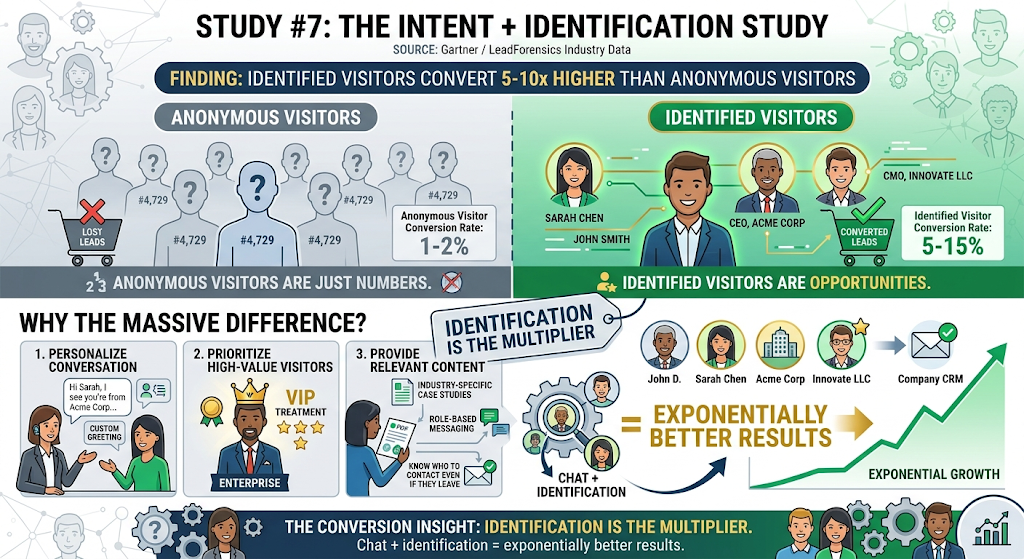
When you know who’s visiting, you can:
- Personalize the conversation (“Hi [Name], I see you’re from [Company]…”)
- Prioritize high-value visitors (Enterprise company? VIP treatment)
- Provide relevant content (Industry-specific case studies, role-based messaging)
- Follow up intelligently (Even if they leave, you know who to contact)
Anonymous visitors are just numbers. Identified visitors are opportunities.
The chat connection:
Most chat tools can’t identify visitors. They can converse, but they’re blind.
Chat tools with visitor identification change the entire equation. You’re not just chatting — you’re chatting with context. That context multiplies conversion.
The conversion insight:
Identification is the multiplier. Chat + identification = exponentially better results.
What The Studies Actually Prove
Let me synthesize what the data tells us.
Live chat works. The ROI is real. The conversion lift is measurable. This isn’t theory.
But not all chat is equal. Basic chat — reactive, generic, understaffed — delivers mediocre results. Advanced chat — proactive, contextual, available, identified — delivers exceptional results.
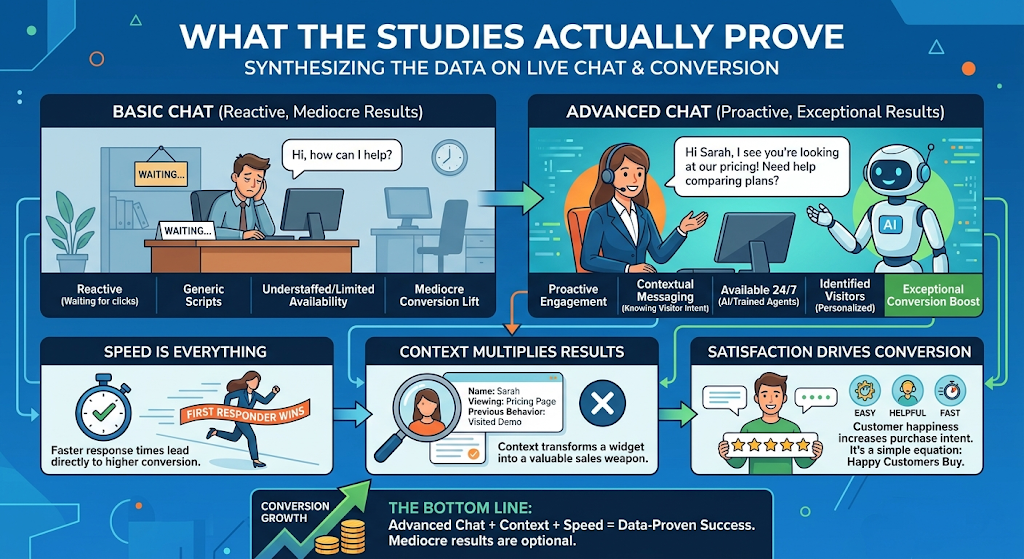
Speed is everything. First responder wins. Chat is the fastest channel. But only if someone (or something) is actually responding.
Context multiplies results. Knowing who’s visiting, what they’re looking at, what they’ve done before — this context transforms chat from a widget into a weapon.
Satisfaction drives conversion. Chat makes customers happy. Happy customers buy. Simple equation.
The Gap Most Companies Miss
Here’s what’s interesting.
Most companies know live chat works. The studies are public. The data is clear.
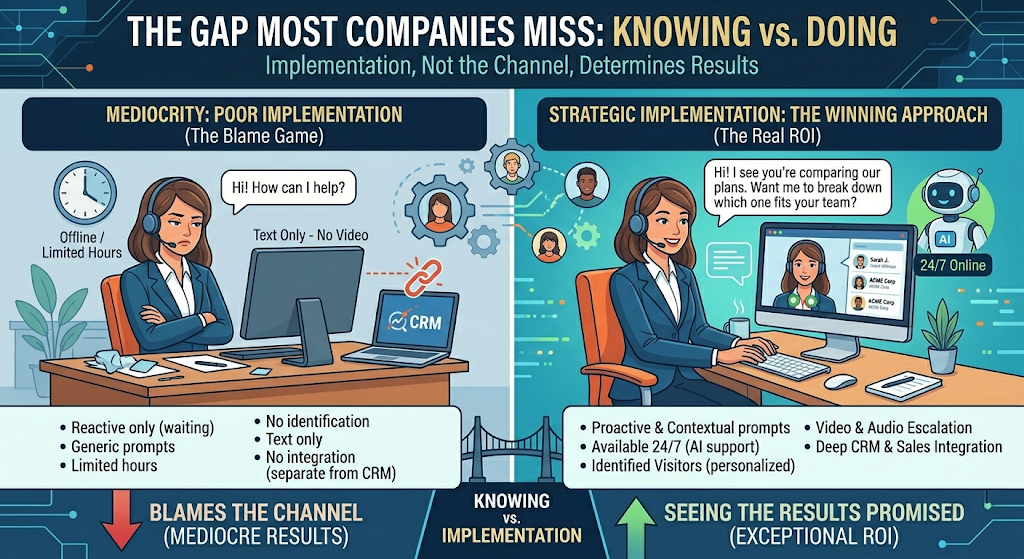
Yet most companies implement chat poorly:
- Reactive only (waiting for visitors to start)
- Generic prompts (“Hi! How can I help?”)
- Limited hours (offline more than online)
- No identification (treating everyone the same)
- No video (text only, no escalation)
- No integration (chat separate from CRM, separate from sales)
They read the studies. They install chat. They don’t see the results the studies promise.
Then they blame the channel instead of the implementation.
The channel isn’t the problem. The implementation is.
What High-Converting Chat Actually Requires
Based on the studies, here’s what works:
1. Instant response (Study #1) AI that engages immediately, 24/7. No “leave a message.”
2. Proactive engagement (Study #4) Reach out at the right moment, with the right message. Don’t wait.
3. Visitor identification (Study #7) Know who’s visiting. Personalize accordingly. Prioritize high-value.
4. Contextual messaging (Studies #3, #4) Reference what they’re looking at. Show intelligence. Be relevant.
5. Video escalation (Studies #1, #3) When they’re ready, go face-to-face. One click. No scheduling.
6. CRM integration (Study #2) Every conversation logged. Every lead captured. Nothing falls through.
That’s not basic chat. That’s a conversion system.
Why Knock Knock Exists
We built Knock Knock because the studies were clear but the tools weren’t there.
Basic chat delivers basic results. The studies prove what’s possible with advanced implementation. But most chat tools don’t support advanced implementation.
Knock Knock does:
- Visitor identification — Name, company, email, LinkedIn. Before they type.
- Behavior tracking — Every page, every scroll, real-time intent scoring.
- Contextual AI — Messages based on what they’re doing, not generic scripts.
- Proactive engagement — Trigger-based outreach at the right moment.
- Live video — One click to face-to-face. While they’re still on site.
- CRM sync — Native integration with GoHighLevel, HubSpot, everything else.
It’s what the studies describe. Built into one platform.
The Choice
The studies prove live chat works.
They also prove that how you implement it determines whether you see 2% conversion or 15% conversion.
Same channel. Wildly different results.
You can install basic chat and wonder why the studies lied.
Or you can implement what the studies actually measured: proactive, contextual, identified, instant, integrated chat.
The data is clear. The question is what you do with it.
See The Difference
We’re running a free webinar where we show exactly what high-converting chat looks like.
You’ll see:
- Visitor identification in real-time
- Proactive, contextual engagement
- AI that actually converts
- One-click video escalation
- The full flow from visitor to customer
[Register for the Free Webinar →]
The studies prove it works. Now come see it work.
Written by Anna Hyatt, Co-Founder of Knock Knock App.
Frequently Asked Questions
Are these studies still relevant in 2026? Yes. The underlying psychology hasn’t changed. Speed still matters. Personalization still matters. The technology to deliver has improved, but the principles hold.
My industry is different. Do these studies apply? The studies span B2B, B2C, e-commerce, services, SaaS. The specifics vary but the patterns are consistent. Chat converts higher when done right, regardless of industry.
What if I don’t have budget for advanced chat tools? Start with what you have. Implement proactive triggers. Train your team. Add identification when budget allows. Incremental improvements still yield results.
How do I convince my team/boss that chat is worth investing in? Share this article. The Forrester ROI study ($6 return per $1 spent) is compelling. The speed-to-lead data is hard to argue with. Let the studies make the case.
What’s the minimum I need to see results? Proactive engagement + available response (AI or human) + CRM integration. That foundation will outperform most competitors.
How quickly will I see improvement? Engagement increases are immediate (first week). Conversion improvements typically show within 30-60 days as you refine and optimize.
Is AI chat as good as human chat? For the first 60-70% of the conversation? Often better. AI is faster, more consistent, available 24/7. Human handoff for complex questions or closing maintains the personal touch when it matters.

Anna Hyatt
Co-Founder | Knock Knock App
AI × Human Touch = Happier Clients, More Revenue
LinkedIn Profile


