Think about that for a second. We’re spending more money than ever to get people to our websites, but many businesses still struggle to get visitors to take meaningful action once they’re there.
So what’s going on? Why are we investing so heavily in getting traffic but still struggling to turn visitors into customers?
The answer isn’t necessarily about needing better tools or fancier websites. We already have some pretty effective tools. The real issue can be something deeper – something I call “digital indifference” – where visitors simply don’t feel engaged enough to take the next step.
Let’s Look at the Numbers
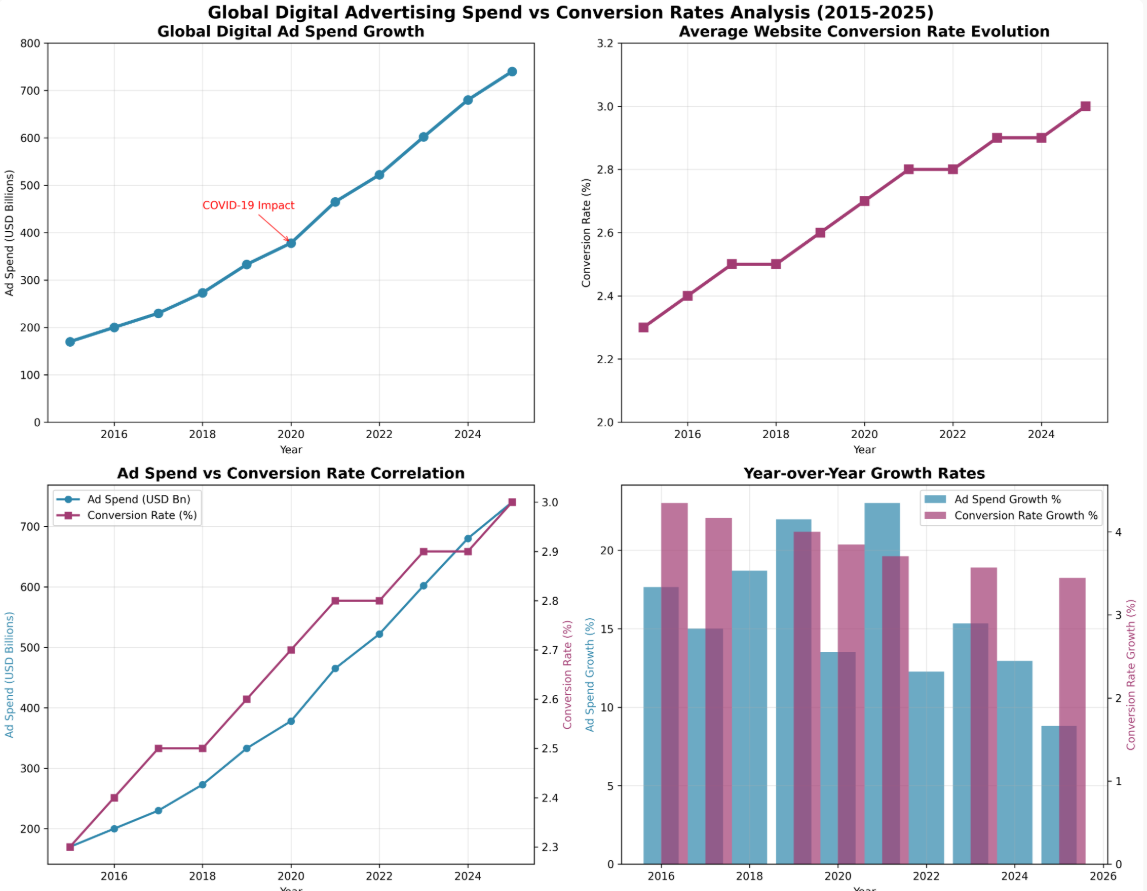
Take a look at this data comparing digital ad spending with changes in conversion rates:

The broader point is that increasing traffic and advertising investment doesn’t automatically translate into proportional improvements in conversion rates.
A large percentage of website visitors can still leave without completing the action a business wants them to take. And despite advances in digital marketing and optimization technology, improving that percentage remains an important challenge.
The Truth: A Decade Later
What do the past ten years teach us?
CRO tools can work well when they’re used appropriately and tested against clear business goals.
Conversational marketing and AI chatbots can also help businesses engage visitors, answer questions, and support customers when implemented effectively.
The tools themselves aren’t necessarily the problem. The challenge is that even with these tools available, many visitors still leave websites without converting.
Digital advertising also involves costs beyond the media itself, including technology, platforms, measurement, and other parts of the advertising ecosystem. That makes it even more important for businesses to focus not only on acquiring traffic but also on what happens after visitors arrive.
So if we have increasingly capable tools but still face conversion challenges, what’s really going on?
What Exactly Is Digital Indifference?
Digital indifference isn’t people actively hating your website or product. It’s people simply not caring enough to take action.
Think about your own browsing habits. How many websites do you visit in a day? How many of those actually get you to do something meaningful? Probably not many, right?
Here’s what can contribute to digital indifference:
Lack of Trust: People can be skeptical online. They may not be sure whether they can trust a website with their personal information or credit card details, especially if they’ve never heard of the company before. Without enough trust, some visitors may browse without committing.
Lack of Human Support When Needed: When people have questions or concerns, there isn’t always someone available to help them in the moment. They’re often left to figure things out on their own, and some may leave if they can’t find what they need. It’s like being in a store with no salespeople around.
Poor User Experience: Ever tried to buy something online and the checkout process was a nightmare? Baymard Institute tracks research showing that a substantial share of online shopping carts are abandon their shopping carts. Cart abandonment can happen for many reasons, including additional costs, checkout friction, delivery expectations, trust concerns, or customers simply browsing.
People Don’t Feel Connected to the Experience: Some websites can feel cold and impersonal. They may treat every visitor in essentially the same way rather than responding to different questions, concerns, or needs. Creating a more relevant experience can help businesses give visitors more reasons to continue engaging.
Slow Follow-Up: Even when people show interest – maybe they browse products, add items to their cart, or spend time on pricing pages – follow-up may not happen while that interest is still fresh. By the time someone reaches out, the visitor may already have moved on.
This suggests that conversion isn’t only a technology problem. Human connection, trust, timing, and relevance can also play important roles.
CRO Tools: Highly Effective, But Treating Symptoms?
Let’s be clear – Conversion Rate Optimization tools can be extremely useful. They help businesses identify friction, test improvements, and understand how visitors interact with digital experiences. DemandSage’s data also highlights a range of CRO statistics and research, although actual returns vary significantly by business, implementation, traffic quality, and methodology.
These tools help you test different headlines, button colors, and page layouts. They show you heatmaps of where people click and scroll. They’re useful for finding and fixing problems that may prevent conversions.
But here’s the thing: CRO tools are like having a really good emergency room for a broken leg. They can be effective at treating the immediate problem, but they don’t necessarily address every reason the problem occurred in the first place.
CRO tools optimize the experience for visitors by reducing friction, improving clarity, and helping businesses test which experiences perform better.
But they don’t necessarily address the fundamental issue: why do so many people visit a website without becoming sufficiently interested or engaged to take the next step?
It’s like this – if someone walks into your store but they’re not really interested in buying anything, rearranging the shelves and improving the checkout process may not be enough to change their mind. You may also need to engage with them and understand what they need.
That’s a gap optimization alone may not always fill. Removing barriers is valuable, but businesses may also need to create meaningful engagement.
AI Chatbots and Conversational Marketing: Addressing the Human Element
Now we’re getting to something that tackles digital indifference more directly. Instead of just optimizing static web pages, chatbots and conversational marketing try to actually engage with people.
Some studies and industry reports suggest that conversational tools can improve engagement and support outcomes when implemented effectively. Glassix did a study discussing the potential impact of AI chatbots on conversions and issue resolution, although results will vary depending on the business, audience, implementation, and methodology.
Why can chatbots be useful? Because they can address some of the issues behind digital indifference:
They’re There When You Need Them: Instead of making people hunt around for answers, chatbots can jump in right when someone looks confused or stuck.
They Feel More Personal: A good chatbot can ask questions and provide more relevant recommendations. It’s not human, but it can offer a more interactive experience than simply reading through generic FAQ pages.
They Can Support Trust: When someone can get timely answers to their questions, it can help them better understand the company, product, or service.
They Can Engage at Relevant Moments: Depending on the technology and configuration, chatbots can engage visitors based on behavior or other available signals.
Qualified’s research also discusses a range of conversational marketing statistics and trends related to real-time communication, chatbots, and customer engagement.
The broader takeaway is that conversation can add another layer to the digital experience beyond simply showing visitors more pages, ads, or static information.
But even when chatbots improve engagement, many visitors may still leave without converting. That highlights the deeper challenge.
The Real Problem: We’ve Forgotten How to Be Human Online
After looking at all this, here’s what I think is really going on:
We have effective tools that can work well for engaged visitors. But as businesses optimize and automate more of the customer journey, it’s important not to lose the human qualities that can make interactions feel relevant, helpful, and trustworthy.
Think about it – when you have a great experience with a company, what makes it great? Often, it’s because someone understood what you needed, treated you like a person, and helped you feel confident about your decision.
That’s something digital experiences can struggle to recreate. Even with CRO tools and increasingly capable chatbots, some online interactions can still feel robotic or impersonal.
Businesses that create experiences where visitors feel understood and valued can differentiate themselves from experiences built entirely around automation.
The Real Solution: Humanize the Digital Buying Experience

Here’s what I think we need to do: we need to humanize the digital buying experience while maintaining the convenience and scale of digital technology.
Think about when you walk into a good store or visit a service provider’s office. What happens? A salesperson notices you’re there. They observe what you’re looking at, how you’re behaving, whether you seem interested or just browsing. If you appear genuinely interested in something, they may approach you at an appropriate moment and offer help.
When this happens well, you can feel seen, valued, and engaged. Someone is actually paying attention to what you need, which can make the buying experience more helpful and reassuring.
Now imagine someone visiting your website. A more humanized digital experience could notice their presence, observe who they are using available and appropriate visitor information, understand what they’re interested in, identify signals of buying intent, and create opportunities to engage at relevant moments.
But here’s what can happen on many websites: visitors arrive, browse independently, encounter questions or uncertainty, and have no immediate path to personalized help. Some of those visitors simply leave.
What a Humanized Digital Experience Actually Looks Like
Someone Notices When You Arrive: Just like a good salesperson acknowledges you when you walk in, a digital experience can recognize when someone visits and start paying attention to available behavioral signals.
They Watch What You’re Interested In: If someone spends time looking at specific products or services, lingers on pricing pages, or keeps coming back to the same section, that can provide useful information about their interests or intent.
They Approach at the Right Moment: Instead of bombarding everyone with pop-ups the second they arrive, smart engagement happens when someone shows genuine buying signals based on the signals and workflows available to the business.
They Actually Help: Real help means understanding what someone is trying to accomplish and guiding them there, not just pushing them toward a purchase.
They Make You Feel Valued: The best shopping experiences can make customers feel that their questions and needs are being taken seriously rather than treating every interaction as identical.
Current tools address different parts of this experience. CRO tools can optimize mechanics and reduce friction. AI chatbots can answer questions and create interactive conversations. Human teams can contribute judgment, empathy, context, and expertise when needed.
What’s difficult to automate completely is the kind of human intuition a skilled salesperson can bring – understanding nuance, asking the right follow-up question, and helping someone navigate a decision.
The Massive Opportunity Hidden in Plain Sight
Even relatively small improvements in conversion rates can have a meaningful impact for businesses with substantial website traffic.
But those improvements don’t necessarily have to come from optimizing the same approaches alone. Businesses can also explore ways to bridge digital efficiency with more relevant and human-centered engagement.
Companies that create websites where visitors can find useful information, receive timely assistance, and access human expertise when needed may be better positioned to turn more of their existing traffic into meaningful conversations and opportunities.
We don’t need to abandon our effective CRO tools or sophisticated chatbots. We can use them as part of a larger strategy that puts human connection at the center of the digital experience.
At Knock Knock, we’re building around this kind of approach. We combine AI-assisted engagement with opportunities for human interaction to help businesses create more connected digital experiences. The goal isn’t simply more automation – it’s using technology to support better conversations and more relevant human connections at digital scale.
The tools are evolving. The technology is becoming more capable. The opportunity is to use it without losing the human element.

Anna Hyatt
Co-Founder | Knock Knock App
AI × Human Touch = Happier Clients, More Revenue
LinkedIn Profile


