You’re paying for traffic. Ads, SEO, content, social. Money and time pouring into getting people to your website.
And then what?
They land. They browse. They leave. No call. No conversation. No sale.
Many website visitors leave without taking action. That’s a lot of potential interest that never becomes a conversation.
The problem isn’t always your traffic. It’s what happens after visitors arrive.
You need a tool that can help turn relevant website visitors into live sales conversations while they’re still on your site and actively interested.
So which tools can help you do this?
Let’s look at what matters and where Knock Knock App fits.
The Real Problem: Traffic Without Conversion
Let’s be honest about what’s happening on many websites.
The typical flow:
- Visitor lands on your site
- They browse a few pages
- Maybe they scroll your pricing page
- They leave
- You may never know they were there
- The opportunity to start a conversation disappears
The gap: Between “interested visitor” and “sales conversation,” there’s often a disconnect. Many tools collect leads for later. They send emails. They rely on visitors returning or taking another action.

But relying on that alone can mean missed opportunities.
A useful real-time engagement platform should be able to do three things:
- Identify relevant visitor or company information where available
- Engage visitors based on relevant signals while they’re actively browsing
- Connect qualified prospects to a human for a live conversation when appropriate
Different platforms address different parts of this process.
Knock Knock App is designed to bring these capabilities together.
What Makes Knock Knock App Different
Knock Knock App is a real-time visitor engagement platform. It uses available visitor intelligence, engages them with AI, qualifies them through conversation, and can connect them to your sales team via live video, voice, or chat.
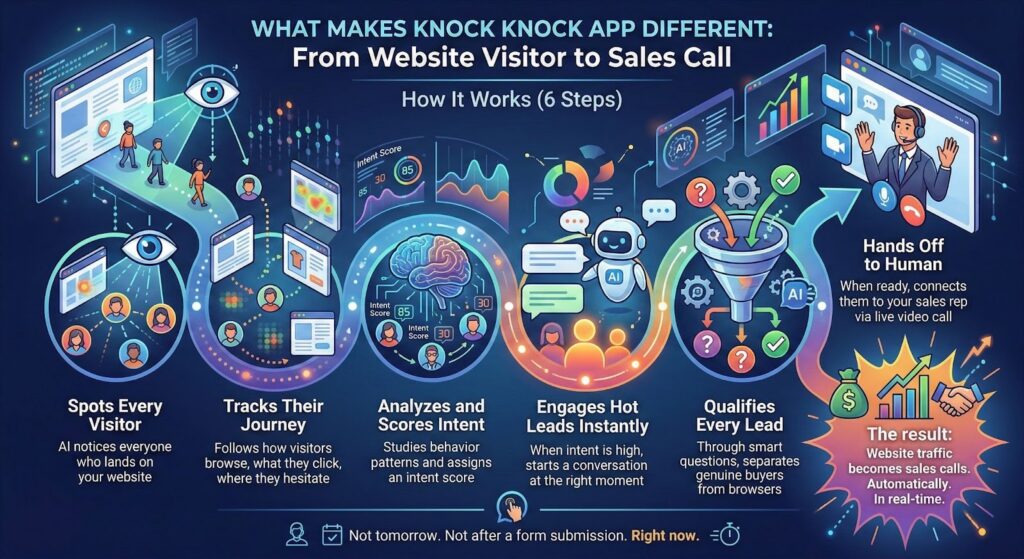
How It Works (6 Steps)
| Step | What Happens |
| 1. Spots Every Visitor | AI notices everyone who lands on your website |
| 2. Tracks Their Journey | Follows how visitors browse, what they click, where they hesitate |
| 3. Analyzes and Scores Intent | Studies behavior patterns and assigns an intent score |
| 4. Engages Hot Leads Instantly | When intent is high, starts a conversation at the right moment |
| 5. Qualifies Every Lead | Through smart questions, separates genuine buyers from browsers |
| 6. Hands Off to Human | Can connect relevant prospects to your sales team via live video or other supported channels |
The goal: Help turn more website activity into meaningful sales conversations in real-time.
Why Other Tools Fall Short
Let’s look at what else is out there and the role different types of platforms can play.
Visitor Identification Tools (Leadfeeder, Clearbit, 6sense)
What they do: Visitor identification platforms can help businesses understand which companies or accounts are interacting with their websites, depending on the platform and available data.
The gap: Identification alone doesn’t necessarily create a conversation. Your team still needs an engagement and outreach process to act on the information.
By the time manual outreach happens, the visitor may no longer be actively browsing.
Identification provides insight. Engagement determines what you do with it.
Chatbots (Drift, Intercom, HubSpot Chat)
What they do: Chat and conversational platforms provide website messaging capabilities, with features varying considerably by provider and plan.
The consideration: Compare how each platform handles proactive engagement, AI, visitor intelligence, human handoff, video, and other communication channels.
Visitors who don’t interact with a chat experience may require a different engagement approach.

The effectiveness of chat depends heavily on how and when it’s used.
Callback Tools (CallPage, Novocall)
What they do: Callback platforms are designed to help website visitors request phone conversations with sales or support teams.
The consideration: Depending on the platform, visitors may need to provide contact information or initiate the callback request themselves. Visitor intelligence, AI qualification, and video capabilities vary by provider.
Callback tools can be useful when a visitor is already ready to request a conversation.
Marketing Automation (HubSpot, Marketo, ActiveCampaign)
What they do: Marketing automation platforms can capture leads, run nurture campaigns, score engagement, and support longer-term customer journeys.
The consideration: Marketing automation and real-time website engagement solve different problems. Nurture campaigns can support prospects over time, while real-time engagement focuses on opportunities that exist during an active website session.
Both can play useful roles at different stages of the buyer journey.
CRM Platforms (Salesforce, Pipedrive, Zoho)
What they do: Store and manage customer and prospect information and help teams track opportunities through the sales process.
The consideration: CRM platforms primarily help manage relationships and sales activity once relevant data enters the system. Website engagement capabilities vary by platform and integrations.
CRM and real-time engagement platforms can complement each other.
The Knock Knock App Advantage
Here’s how Knock Knock App approaches the process:
1. Visitor Intelligence Before Engagement
Instead of relying exclusively on form submissions, Knock Knock can use available visitor intelligence and identify relevant visitor information when they land.
| What You May Know | Before Form | After Form |
|---|---|---|
| Name | Where available | Usually available if collected |
| Where available | Usually available if collected | |
| Company | Where available | Available if collected or enriched |
| Job Title | Where available | Available if collected or enriched |
| LinkedIn Profile | Where available | May be available |
| Traffic Source | Where tracked | Where tracked |
| Pages Viewed | Real-time | Can be retained |
| Time on Site | Real-time | Can be retained |
| Intent Score | Based on configured signals | Can continue updating |
The exact information available depends on the visitor, geography, data sources, consent, privacy settings, and identification coverage.
2. Behavior-Based Engagement
The AI doesn’t have to simply sit there waiting. It can use supported behavior and configured criteria to determine when engagement may be useful.
Potential triggers can include:
- Visitor spends meaningful time on a pricing page
- Visitor returns to the site
- Visitor engages deeply with a case study
- Visitor reaches a relevant stage of the website journey
- Visitor matches configured customer criteria
- Intent score crosses a configured threshold
The AI engages when buying signals are highest. The specific triggers and timing should be configured around your sales process and visitor experience.
3. AI Qualification (24/7)
The AI can do more than simply say “How can I help?” It can help qualify.
- Ask relevant questions based on available context
- Use supported context from the visitor journey
- Capture qualification information
- Route relevant leads based on configured criteria
- Handle common questions before human involvement
This can help your sales team prioritize relevant prospects. The effectiveness depends on how the AI is configured and the quality of the qualification process.
4. Human Takeover
Here’s where the AI and human sales process can work together.
Your sales rep can review available conversation and visitor context. When appropriate, they can take over the conversation and continue from the information already gathered.
That can reduce the need for visitors to repeat information and create a smoother transition from AI to human engagement.
From AI to human with useful context.
5. Live Video Calls
When a conversation benefits from face-to-face interaction, your team can escalate to live video while the visitor is still on your site.
This can reduce unnecessary steps such as:
- Sending a calendar link when someone is available now
- Waiting for a separately scheduled conversation
- Losing momentum between website engagement and human interaction
Face-to-face conversation when the visitor and your team are both available.
6. Camera Flip
Selling a physical product? Real estate? Equipment?
Where supported, your rep can use the camera during a live conversation to demonstrate products, spaces, equipment, or other relevant details.
Show, don’t just tell. Live.
Why Real-Time Matters
Response time can influence the likelihood of connecting with an interested prospect, particularly when someone has actively expressed interest.
But there isn’t one response-time benchmark or conversion multiplier that applies to every business.
Factors such as lead source, purchase intent, industry, deal size, sales process, traffic quality, and the type of inquiry can all affect outcomes.
The advantage of real-time engagement is straightforward: it gives your team an opportunity to start a conversation while the visitor is still actively engaging with your website.
Knock Knock App is designed to support that process by combining AI engagement with opportunities for human takeover and live conversations.
Who Is Knock Knock App For?
Knock Knock App can be particularly useful for businesses where:
High-Ticket Sales
If every qualified conversation has meaningful potential value, creating more opportunities for direct engagement can be valuable. The actual ROI will depend on your traffic, deal economics, conversion process, and implementation.
Considered Purchases
Products or services that need explanation, demonstration, or trust-building can benefit from opportunities for direct conversation.
Competitive Markets
In industries where buyers compare multiple providers, responsive and personalized engagement can help create a differentiated customer experience.
Service Businesses
Consultants, agencies, and professional services often rely heavily on conversations and trust. Live interaction can provide another way for prospects to meet the people behind the service.
Real Estate
Potential buyers may browse listings outside traditional business hours. AI-powered qualification and live communication options can help teams create a more responsive experience when representatives are available.
SaaS Sales
Demo requests can happen in real-time instead of 3-day scheduling loops when both the prospect and sales team are available. Product questions can also be addressed through live conversations.
What Knock Knock App May Not Be For
Let’s be honest about where the fit may be weaker:
- Low-ticket, highly transactional e-commerce – Live sales conversations may provide less value when purchases require little consideration
- Pure self-serve SaaS – Businesses designed around fully self-service buying may have less need for human takeover
- Businesses without sales capacity – If no one is available for live conversations, some human-engagement capabilities may be less useful
- Very low-traffic websites – Businesses may need to consider whether their current traffic volume justifies additional visitor-engagement technology
Pricing
Pricing and plan features can change over time.
For the most accurate information, review Knock Knock’s current plans before comparing costs or calculating potential ROI.
The financial value will depend on your selected plan, website traffic, sales process, existing technology costs, and the business outcomes generated.
How It Compares
Knock Knock’s approach is to combine visitor intelligence, AI-powered engagement, qualification, and real-time human interaction within one platform.
| Capability | Knock Knock App | Visitor-ID Platforms | Chat Platforms | Callback Tools |
|---|---|---|---|---|
| Visitor Intelligence | Yes | Core capability | Varies | Varies |
| Behavior Tracking | Yes | Common | Varies | Limited |
| Intent Scoring | Yes | Available on some platforms | Varies | Limited |
| AI Engagement | Yes | Varies | Common on many platforms | Varies |
| AI Qualification | Yes | Varies | Available on some platforms | Varies |
| Human Takeover | Yes | Usually requires another workflow | Common on many platforms | Phone-based |
| Live Video Chat | Yes | Varies | Varies | Varies |
| Voice Communication | Yes | Varies | Varies | Core capability |
| Camera-Based Interaction | Yes | Varies | Varies | Varies |
| 24/7 AI Availability | Yes, when configured | Varies | Varies | Varies |
| CRM Integration | Available | Common | Common | Common |
When comparing it with alternatives, verify each provider’s current capabilities, integrations, limitations, and pricing directly.
Getting Started
Implementation time depends on your website, integrations, AI configuration, sales process, and internal resources.
A typical implementation process may include:
Initial Setup:
- Install the required website tracking or widget code
- Connect your CRM and relevant systems
- Configure AI behavior and qualifying questions
Configuration and Testing:
- Set engagement triggers based on your sales process
- Train your team on human takeover workflows
- Test the experience with internal traffic
Launch:
- Go live
- Monitor AI conversations
- Refine triggers based on actual interactions
Ongoing Optimization:
- Review performance data
- Test engagement timing and messaging
- Adjust qualification criteria and workflows based on results
The Bottom Line
The question: Which tool can help turn website traffic into sales calls?
Knock Knock App is designed specifically around connecting visitor intelligence, AI engagement, qualification, and real-time human conversations.
Here’s the idea in one sentence:
It uses available visitor intelligence, AI-powered engagement and qualification, and live communication tools to help businesses create opportunities for sales conversations while prospects are still on the website.
Other platforms may offer some or many of these capabilities, so the right choice depends on your requirements, existing technology stack, budget, and sales process.
If you’re paying for traffic but struggling to turn website activity into conversations, real-time visitor engagement is one approach worth evaluating.
Try It
, if applicable to the current offer.
See your visitors. Watch how the AI engages. Explore human takeover and live communication features.
Then decide whether it fits your sales process.
Frequently Asked Questions
How does Knock Knock identify visitors without a form? Knock Knock can use available visitor intelligence and supported data sources to provide information about website visitors or associated companies. The information available varies by visitor, geography, data availability, privacy settings, consent requirements, and identification method. Businesses should configure visitor identification in accordance with applicable privacy and data-protection requirements.
Does the AI feel robotic to visitors? The experience depends on how the AI is configured, trained, and integrated with your website. Knock Knock can use available visitor and conversation context to create more relevant interactions, but businesses should clearly design and test their AI experience rather than assume every visitor will respond to it in the same way.
What if no one is available to take calls? AI-powered conversations can continue when team members aren’t available, depending on your configuration. The system can gather information, answer supported questions, qualify visitors, and support follow-up workflows such as meeting booking where configured.
Can I use this with my existing CRM? Knock Knock has native integrations with GoHighLevel and HubSpot. Additional CRM connectivity may be available through supported integrations or automation platforms. Verify the current integration options for the CRM and workflow you use.
What about mobile visitors? Knock Knock supports website engagement across compatible devices. The exact experience and available capabilities can depend on the visitor’s device, browser, permissions, and configuration.
How is this different from Drift or Intercom? Knock Knock is designed around combining visitor intelligence, AI-powered engagement, qualification, and real-time human communication, including live video. Drift, Intercom, and other platforms have their own feature sets and product strategies, which can change over time, so compare their current capabilities directly against the features your business needs.
What’s the ROI timeline? There isn’t a universal ROI timeline. Results depend on factors such as website traffic, visitor quality, sales capacity, deal value, implementation, AI configuration, engagement strategy, and your existing conversion baseline. Measure performance against your own baseline using metrics such as conversations generated, qualified leads, sales opportunities, conversion rates, and revenue influenced.

Anna Hyatt
Co-Founder | Knock Knock App
AI × Human Touch = Happier Clients, More Revenue
LinkedIn Profile


