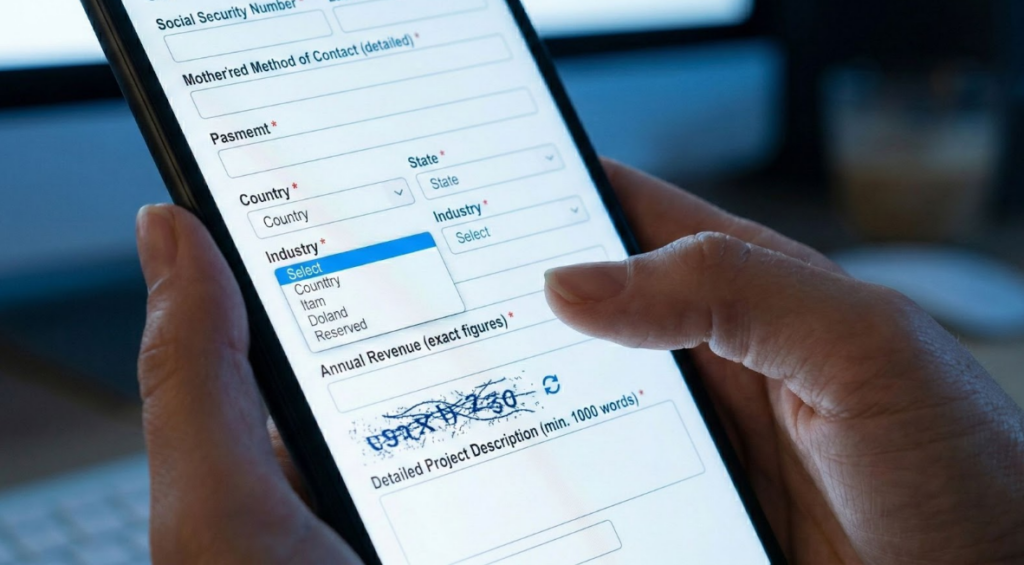
I still remember the moment that changed everything.
I was checking my form submissions and saw something that felt like a punch in the stomach.
A half-filled form.
Name filled. Company filled. Phone number filled.
And then nothing.
Starting a form can be a sign that someone is interested. Filling in several details suggests they were considering taking the next step.
A half-filled form is the digital version of someone approaching your shop counter and walking away without completing the conversation.
That helplessness pushed me to build Knock Knock. But the real lesson wasn’t about forms.
It was about timing.
The Industry Has It Backwards
Many websites struggle to turn visitors into leads or customers.
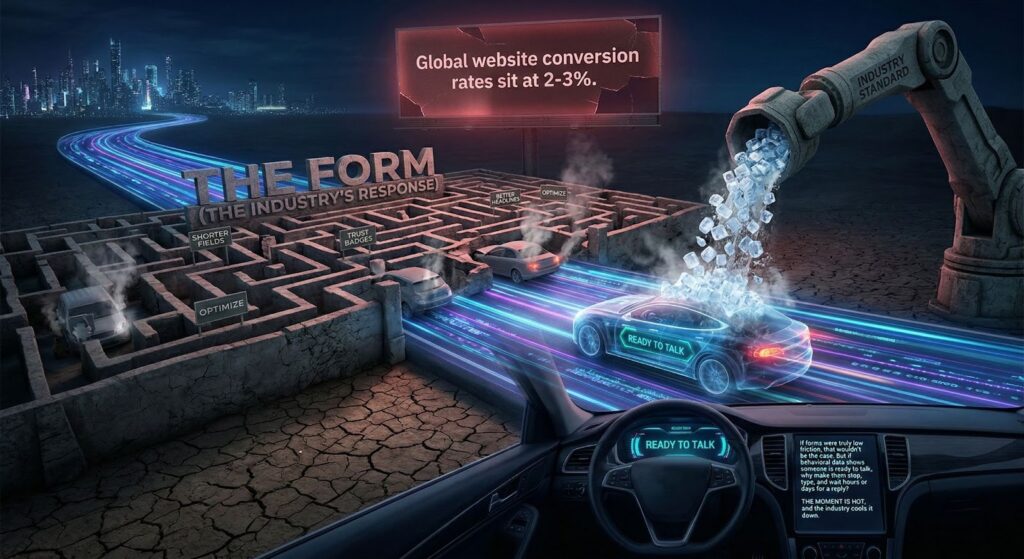
If forms were truly low friction, businesses wouldn’t spend so much time trying to improve them. Yet the industry’s response is often the same: optimize the form. Better headlines. Shorter fields. Trust badges.
But here’s the question.
If behavioral signals already suggest someone may be ready to talk, why make them stop, type, and wait for a later reply?
The moment is active, and unnecessary friction can slow it down.
Forms Protect Companies, Not Buyers
Forms are useful for collecting information and organizing inquiries.
But they’re often designed around the company’s workflow rather than the buyer’s immediate need.
They let sales teams batch inquiries, respond according to availability, and collect structured information before starting a conversation.
For the buyer, that can mean waiting.
Changing a form is comfortable. Removing or reducing dependence on it can feel more challenging.
Many companies focus on form design because it allows the existing sales process to remain largely unchanged. Tweaking headlines and fields keeps the old process intact.
But replacing a form at a high-intent moment with real-time engagement can require rethinking the sales workflow.
Forms make delayed follow-up possible. Conversations require greater availability.
Neither approach is automatically right for every situation.
But when someone is actively interested and wants help now, requiring a form before they can speak to someone may create unnecessary friction.
The Shelf Life of Intent Is Minutes, Not Days
When I finally built the system to catch people in real time, the importance of timing became clear.
Buyer intent doesn’t always stay at the same level for long.
Someone may be comparing options, scrolling slowly, re-reading information, or looking for a reason to take the next step.
They’re actively evaluating you.
Then life happens.
Slack pings. A child calls. Their boss walks in. A new tab opens.
They think: I’ll do this later.
Sometimes they return. Sometimes they don’t.
Given enough time, they may also continue researching alternatives or start conversations with other providers.
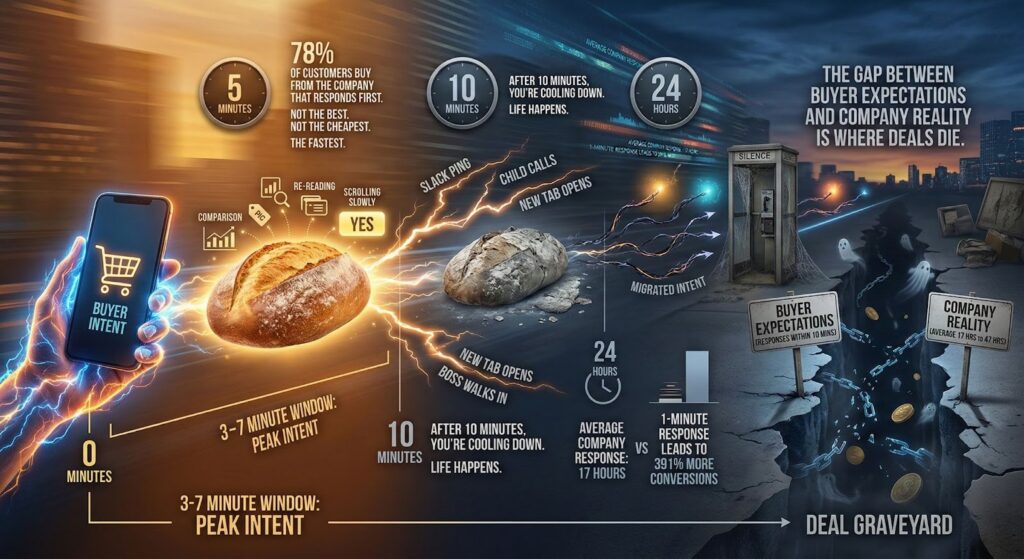
The buyer’s intent may not disappear. Their attention may simply move somewhere else.
That’s why response time matters.
When someone actively expresses interest, responding while they’re still engaged can create a better opportunity for a useful conversation.
The longer the delay, the greater the chance that their attention shifts, circumstances change, or another provider becomes part of the evaluation.
The gap between buyer interest and company response is where opportunities can be lost.
You’re Optimizing the Wrong Moment
If you’re still A/B testing button colors and polishing form copy, make sure you’re not ignoring the experience that happens before the form.
Conversion doesn’t live only on your form.
It can also be influenced by the moments before someone reaches it. When interest is active, curiosity is alive, and the visitor may have questions they want answered.
A better headline, button color, or trust badge can help improve a page, but those changes don’t replace a timely conversation when a visitor wants one.
Your buyer may not need a better form.
They may need an easier way to get help when they’re ready.
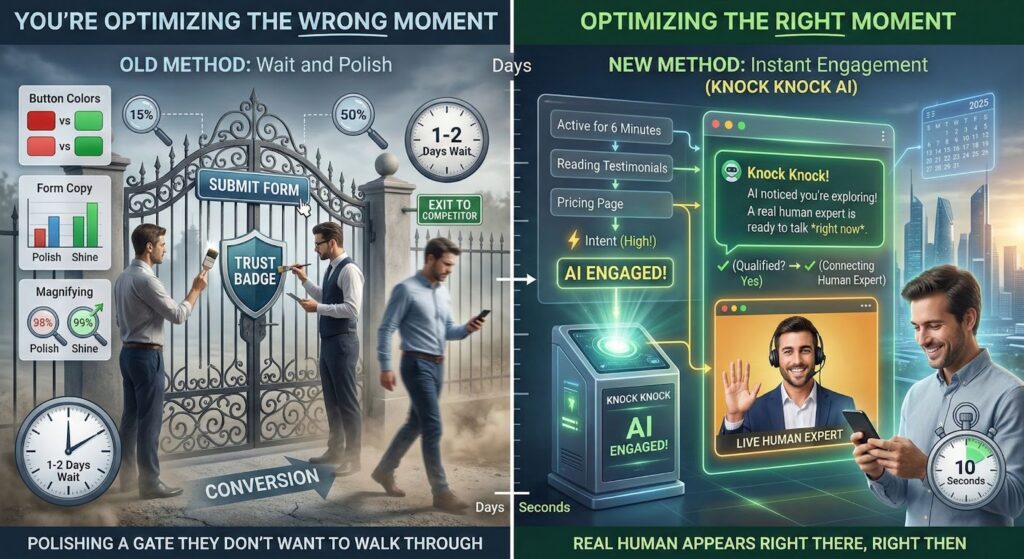
Forms wait. Buyers may not.
That’s one reason I built Knock Knock. AI can use configured behavioral signals to identify moments when engagement may be useful. It can start a conversation, answer supported questions, collect information, and help qualify visitors.
And when appropriate and available, a real human can step into the conversation.
Before the visitor has to leave the website and wait for a later response.
Today, attention is limited and alternatives are often easy to find.
When a visitor is showing signs of interest, giving them an immediate way to continue the conversation can create another opportunity to engage.
Frequently Asked Questions
What’s the best alternative to forms on a website? One alternative is real-time visitor engagement that gives interested visitors another way to start a conversation instead of requiring every interaction to begin with a form. Knock Knock supports this approach. It identifies visitors the moment they arrive when relevant visitor information is available, detects buying behaviour in real-time using supported behavioral signals, can engage proactively with AI, and connects hot leads to humans via live video, voice, or chat when those options are configured and available. Not every visitor will necessarily be identifiable, and the information available can vary. The goal is to reduce unnecessary friction and give interested visitors another way to get help.
Should I remove all forms from my website? Not necessarily. Forms still have their place for specific use cases like newsletter signups, contact requests, applications, or support tickets. But for high-intent moments, when someone is actively considering your service and wants immediate help, real-time engagement can provide an alternative to requiring a form before the conversation begins.
What’s the ideal response time for a lead? There isn’t one universal response time that guarantees better conversion. In general, responding while a prospect is still actively engaged can help your team continue the conversation before attention shifts. Rather than relying on a fixed number of minutes, measure how response time affects qualification and conversion within your own sales process.
How do I know when someone is ready to talk? Behaviour can provide useful signals. Time on pricing pages, multiple page views, return visits, and engagement with key sections can all provide context. AI can detect these signals in real-time and engage at exactly the right moment, based on the behavioral signals and engagement rules you’ve configured. These signals can help prioritize engagement, but they shouldn’t be treated as a guarantee that someone is ready to buy.
What if I can’t have someone available 24/7? AI can help engage visitors outside your team’s normal availability based on how it is configured. It can answer supported questions, collect information, and help qualify visitors. When your team is available, a human can step into relevant conversations. This gives visitors a way to engage even when someone isn’t immediately available for a live human conversation.
Won’t instant engagement feel pushy or intrusive? It can if it’s poorly timed or irrelevant. A generic popup may feel intrusive, while a relevant message based on what someone is viewing can be more useful. For example: “I see you’re looking at our pricing. Want me to walk you through the options?” Visitors should still have the choice of whether to engage.
What happens to the leads who aren’t ready to talk immediately? Depending on the information collected and your configured integrations, relevant lead and conversation information can be passed into your sales workflow for follow-up. That can give your team additional context about what the visitor was interested in and what was discussed, rather than relying only on a basic form submission
How does this work with my existing CRM and sales process? Knock Knock integrates with GoHighLevel, HubSpot, and other CRMs via supported integrations and workflows. Relevant visitor, lead, and conversation information can be passed into connected systems depending on your configuration, helping your existing sales process start with more context rather than replacing it.
What results can I realistically expect? Results vary based on your website traffic, audience, offer, sales process, implementation, and how visitors use the engagement options you provide. Rather than assuming a fixed conversion increase, compare engagement, qualified leads, opportunities, conversions, and associated revenue against your existing baseline.
Ready to stop losing deals to forms?
👉 Try Knock Knock: knockknockapp.ai

Anna Hyatt
Co-Founder | Knock Knock App
AI × Human Touch = Happier Clients, More Revenue
LinkedIn Profile


