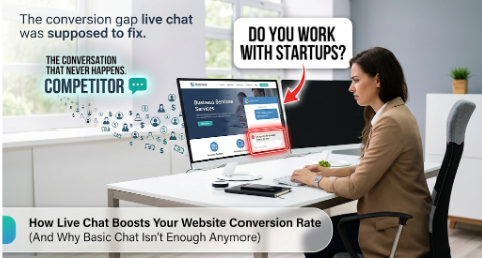
The Conversation That Never Happens
Every day, people land on your website ready to buy.
They have questions. Small ones. “Do you work with companies my size?” “What’s the implementation timeline?” “Can I see a demo this week?”
Simple questions. Quick answers would close the deal.
But there’s no one to ask.
So they leave. They Google another option. They find a company that answers.
You lost a customer you never knew you had. Not because your product was wrong. Not because your price was high. Because nobody was there to talk.
That’s the conversion gap live chat was supposed to fix.
But here’s the thing: basic live chat isn’t fixing it anymore.
The Promise vs. The Reality
Live chat promised instant connection. Real-time conversation. No more waiting for email replies. No more phone tag.

And it delivered. Sort of.
The promise: “Chat with us now!”
The reality: “Please leave a message and someone will get back to you.”
The promise: “Instant answers to your questions.”
The reality: “Hi! I’m a bot. I don’t understand your question. Would you like to speak to a human?” Human unavailable.
The promise: “Convert more visitors into customers.”
The reality: 2-3% conversion rate. Same as before.
What went wrong?
The Evolution of Expectations
Here’s what happened.
In 2015, having live chat on your website was impressive. Visitors thought, “Oh cool, I can chat with someone.” It was new. It was different. It converted.
In 2020, live chat became standard. Everyone had it. The novelty wore off. Visitors expected it.
In 2025, basic live chat is background noise. That little bubble in the corner? Visitors ignore it. They’ve been burned too many times by bots that don’t help and humans that never show up.
The bar has moved.
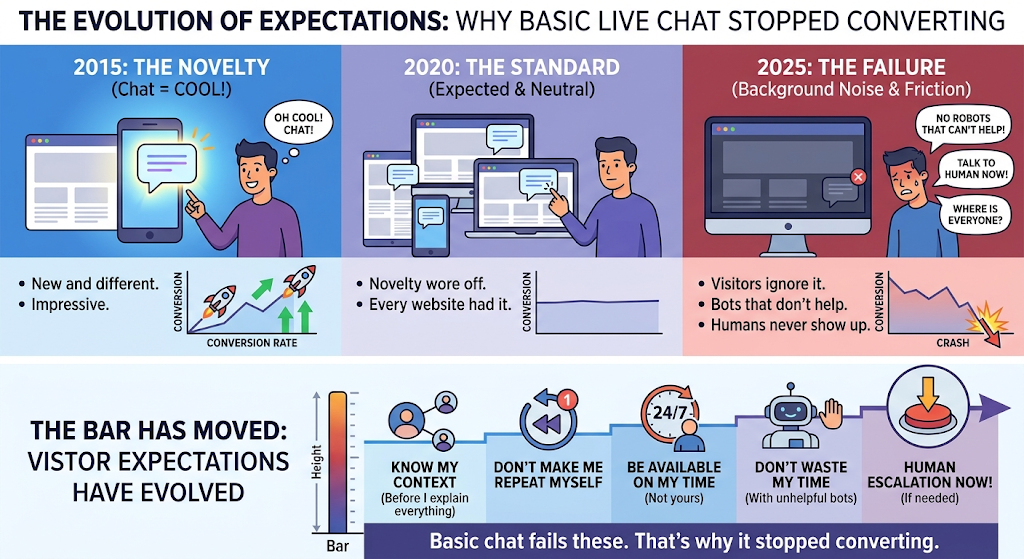
“Chat with us” used to be enough. Now visitors want more:
- Don’t make me repeat myself
- Know something about me before I explain everything
- Be available when I need you, not when it’s convenient for you
- Don’t waste my time with bots that can’t actually help
- If I want to talk to a human, let me talk to a human NOW
Basic live chat doesn’t meet these expectations. That’s why it stopped converting.
The Numbers Nobody Talks About
Let me share some uncomfortable data.
Average live chat conversion rate: 2-5%
That’s not much better than a contact form. After all the hype, all the technology, all the chat widgets… 2-5%.
Why so low?
Reason 1: Nobody’s there Most businesses can’t staff chat 24/7. Visitors land at 9pm. Chat says “leave a message.” They leave, but not a message.
Reason 2: Bots frustrate more than help “I don’t understand your question” is the fastest way to lose a visitor. They came for answers. You gave them a maze.
Reason 3: No context The chat doesn’t know who’s visiting. Doesn’t know what pages they viewed. Doesn’t know this is their third visit. Every conversation starts from zero.
Reason 4: Text is limited Some questions need more than text. “Can you show me how it works?” “What does the dashboard look like?” “Can I see a demo?” Text can’t deliver.
Reason 5: Slow handoffs Visitor chats with bot. Bot transfers to human. Human takes 5 minutes to respond. Visitor is gone.
Basic live chat has a ceiling. Most businesses have already hit it.
What Actually Converts
So what does work?
Let me show you the difference between live chat that converts at 2% and live chat that converts at 15%+.
Basic Live Chat:
- Visitor lands
- Chat bubble appears: “Hi! How can I help you?”
- Visitor types question
- Bot responds with generic FAQ link
- Visitor asks for human
- “Please wait while we connect you…”
- Visitor waits. Waits. Leaves.
Conversion rate: 2-3%

Intelligent Live Chat:
- Visitor lands
- System identifies them: Name, company, email, source
- System tracks behavior: Which pages, how long, what they clicked
- At the right moment, contextual message: “Hi Sarah, I noticed you’re comparing our plans. Want me to break down which one fits a team your size?”
- Visitor engages. AI has actual conversation based on context.
- AI qualifies: budget, timeline, decision-makers
- “Sarah, would you like to hop on a quick video call? Our specialist is available right now.”
- One click. Face-to-face. While visitor is still on the website.
Conversion rate: 15-25%
Same visitor. Same website. Completely different experience.
The Psychology of Why This Works
Let’s break down what’s actually happening.
1. Recognition creates connection
When the chat knows your name, you feel seen. Not like a ticket number. Not like “Visitor #4,729.” Like a person.
That small thing changes everything. You’re more likely to engage. More likely to trust. More likely to buy.
2. Context eliminates friction
“I noticed you’re looking at our enterprise plan” is different from “How can I help you?”
The first shows intelligence. The second feels like a script.
When chat references what you’re actually doing, it feels helpful instead of intrusive. Relevant instead of random.
3. Timing matters more than presence
A chat that pops up the second you land is annoying. A chat that engages after you’ve browsed for two minutes and viewed the pricing page twice? That’s perfect timing.
Intelligent chat waits for buying signals. Then it appears. That’s not interruption. That’s assistance.
4. Speed closes deals
The first company to respond wins 78% of deals. Not the best company. The first.
When chat can connect you to a human instantly, on video, while you’re still interested? That’s speed that closes.
5. Video builds trust faster
Text is anonymous. Voice is better. Video is trust.
When you can see someone’s face, read their expressions, watch them demo something live… you trust them more. Faster. The sale happens.
The Visitor Journey That Converts
Let me walk you through what a high-converting chat experience actually looks like.
Tuesday, 3:47 PM
Marcus lands on your website. He’s an Operations Director at a manufacturing company. Came from a LinkedIn ad.
Your system knows:
- His name (Marcus Chen)
- His company (Apex Manufacturing, 200 employees)
- His title (Operations Director)
- His source (LinkedIn ad about inventory management)
- His history (Second visit this week. Last time spent 4 minutes on case studies.)
Marcus browses.
Features page. 45 seconds. Pricing page. Scrolls to enterprise tier. Back to features. Clicks on “Integrations.”
Your system calculates.
Second visit. Enterprise-level company. Decision-maker title. Viewing pricing and integrations. Intent score: High.
The moment is right.
Chat appears. Not “Hi! How can I help?” This:
“Hi Marcus. I see you’re looking at our integrations — we work with most major ERP systems. Are you evaluating us for a specific warehouse setup?”
Marcus pauses.
That’s specific. That’s relevant. That’s not a bot reading a script.
He types: “Yeah, we run SAP. Wondering about compatibility.”

The AI responds with actual knowledge.
Not “Let me check on that” or “Here’s a link to our FAQ.” A real answer about SAP integration, specific to manufacturing use cases. Mentions similar companies they’ve worked with.
Conversation continues.
Marcus asks about implementation timeline. AI answers. He asks about support during transition. AI answers. Each response is intelligent, contextual, helpful.
AI qualifies.
Through natural conversation:
- Timeline: Q2 implementation
- Budget: Approved
- Decision: Marcus is the primary decision-maker
- Concern: Implementation complexity
The moment is right again.
“Marcus, would you like to hop on a quick video call? David specializes in manufacturing implementations and could walk you through exactly how this would work with your SAP setup. He’s available right now.”
One click.
Live video. Face-to-face. David joins the call. But he’s not going in blind. He sees everything: Marcus’s profile, pages viewed, the entire chat conversation, qualification data.
No awkward intro. No “So tell me about your business.” David already knows.
“Hi Marcus. I see you’re running SAP in your warehouse. We just finished an implementation with a company similar to yours. Let me show you exactly how that worked.”
15 minutes later.
Marcus is impressed. Demo completed. Questions answered. Onboarding call scheduled for next week.
Total time from landing to scheduled call: 23 minutes.
That’s what high-converting live chat looks like.
The ROI Breakdown
Let’s make this concrete.
Scenario: 1,000 monthly visitors
With basic live chat (3% conversion):
- 30 leads per month
- 25% close rate
- 7.5 customers
- $5,000 average deal
- $37,500 monthly revenue
With intelligent live chat (15% conversion):
- 150 leads per month
- 30% close rate (warmer leads)
- 45 customers
- $5,000 average deal
- $225,000 monthly revenue
Same traffic. Same website. Same product.
6x revenue difference.
That’s not a small improvement. That’s a different business.
What “Live” Actually Means Now
Here’s the shift most businesses are missing.
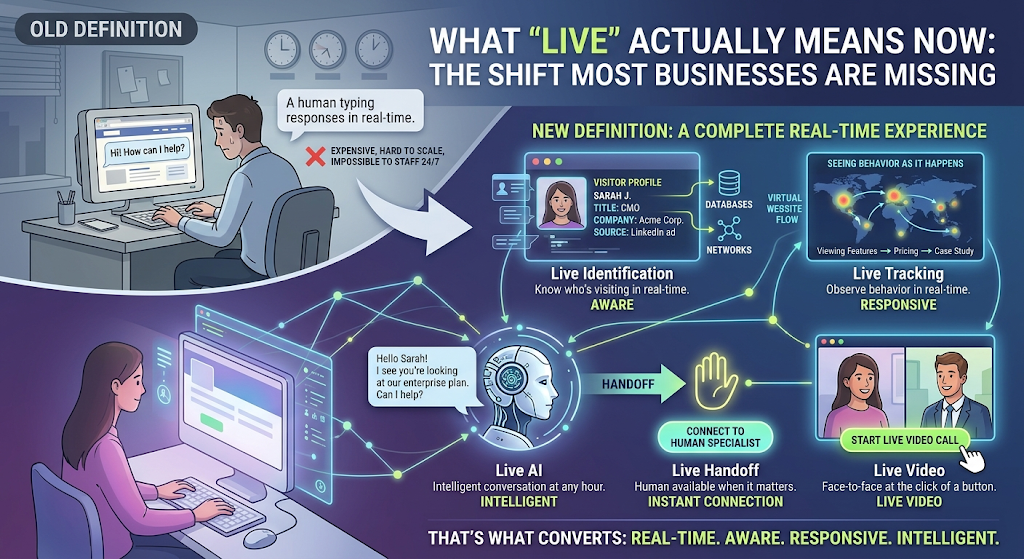
“Live chat” used to mean “a human typing responses in real-time.”
That’s expensive. Hard to scale. Impossible to staff 24/7.
“Live chat” now means something different:
Live identification — Know who’s visiting in real-time Live tracking — See their behavior as it happens Live AI — Intelligent conversation at any hour Live handoff — Human available when it matters Live video — Face-to-face at the click of a button
The “live” isn’t just about response time. It’s about the entire experience being real-time. Aware. Responsive. Intelligent.
That’s what converts.
The Implementation Reality
“This sounds complicated.”
It’s not.
Day 1:
- One line of code on your website (like Google Analytics)
- Connect your CRM (native integrations for GoHighLevel, HubSpot, or Zapier for others)
- Configure your AI (tone, qualifying questions, handoff rules)
Day 2-3:
- Set engagement triggers (when should AI reach out?)
- Train your team on takeover (one-click video, what to say)
- Test with internal traffic
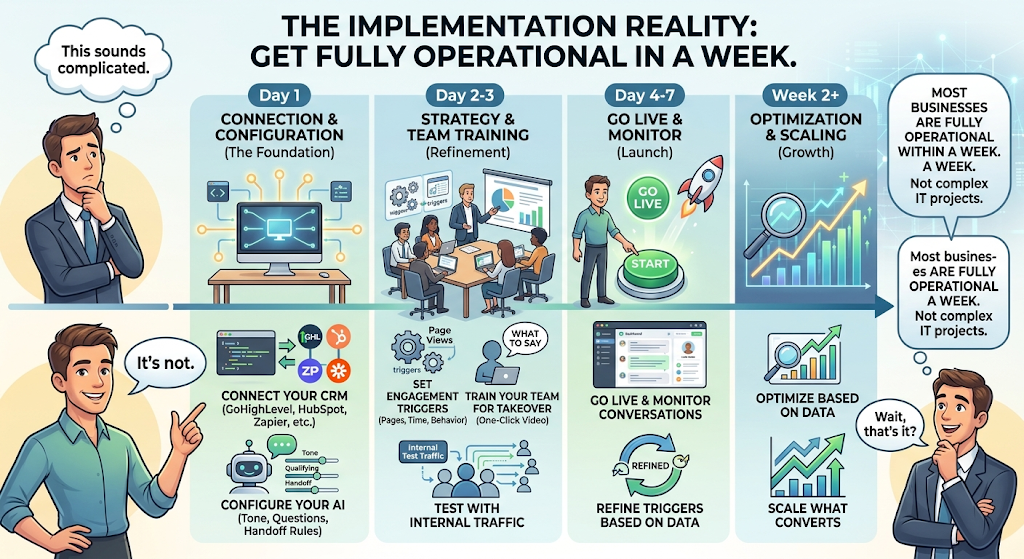
Day 4-7:
- Go live
- Monitor conversations
- Refine triggers based on what’s working
Week 2+:
- Optimize based on data
- Scale what converts
Most businesses are fully operational within a week. Not months. Not complex IT projects. A week.
The Competitive Gap
Here’s the reality right now.
Most of your competitors are still using:
- Basic chatbots that frustrate visitors
- “Leave a message” when no one’s available
- Contact forms that get replies in 24-48 hours
- Scheduled calls that happen days after interest peaked
When a prospect experiences your website — with instant identification, contextual AI, and live video — after experiencing theirs?
The contrast is obvious.
They feel like a ticket number over there. They feel like a priority with you.
That gap is your competitive advantage. And right now, it’s wide open.
Why We Built Knock Knock
I got tired of watching businesses fail with live chat.
Not because chat doesn’t work. Because the tools weren’t built for what actually converts.
Basic chat tools can send messages. But they can’t identify who’s visiting. They can’t track behavior. They can’t score intent. They can’t connect you face-to-face in one click.
So we built something different.
Knock Knock identifies visitors before they engage. Name, company, email, LinkedIn. You know who’s on your site before they type a single character. That changes everything about how you engage.
Knock Knock tracks behavior in real-time. Every page. Every scroll. Every click. How long they stay. Whether they’ve visited before. Intent scored automatically so you know who’s browsing and who’s buying.
Knock Knock engages with context, not scripts. The AI doesn’t say “Hi! How can I help?” It says “Hi Marcus, I noticed you’re looking at our integrations. We work with most major platforms. Are you evaluating us for a specific setup?” Because it actually knows what Marcus is doing.
Knock Knock connects you face-to-face in one click. When text isn’t enough, one click starts live video. While they’re still on your site. While they’re still interested. No calendar links. No scheduling. No three-day wait.
Knock Knock syncs with your CRM automatically. Native integration with GoHighLevel. Works with HubSpot, Salesforce, everything else via Zapier. Every conversation logged. Every lead captured. Your sales team sees full context before they ever speak.
This is what “intelligent live chat” actually looks like.
Not a widget hoping someone clicks. A system designed to convert.
The Question
Your website gets visitors every day. Some of them are ready to buy. They just have questions. They just need a conversation.
Are you giving them one?
Or are you letting them leave because nobody was there to talk?
Live chat boosts conversion. But only the right kind of live chat.
Not the basic bubble that says “Hi!” and then fails. Not the bot that frustrates more than helps. Not the “someone will get back to you” that means you already lost.
Real live chat. Intelligent. Contextual. Human when it matters. Available now.
That’s what converts.
See the Difference
We’re running a free 30-minute webinar where we show you exactly how this works.
You’ll see:
- Basic live chat vs. intelligent live chat (side by side)
- How visitor identification changes the conversation
- How AI engages based on behavior, not scripts
- How one-click video closes deals on the spot
- Real conversion data from businesses using this
[Register for the Free Webinar →]
Your visitors are ready to talk. The question is whether you’ll be there.
Written by Anna Hyatt, Co-Founder of Knock Knock App.
Frequently Asked Questions
I already have live chat on my website. Is this different? Probably yes. Most live chat is basic: a widget, a greeting, maybe a bot. Intelligent live chat includes visitor identification, behavior tracking, contextual engagement, and live video. If your current chat doesn’t know who visitors are before they type, it’s basic.
What about when my team isn’t available? The AI handles everything 24/7. It engages, converses, qualifies, and books meetings. When your team IS available, they can jump in with one click. You get coverage without hiring night staff.
Will visitors find it creepy that we know who they are? No. The experience feels helpful, not invasive. “Hi Sarah, I noticed you’re looking at our pricing” feels relevant. Visitors are impressed, not uncomfortable. They’re used to personalization from Netflix, Amazon, and everyone else.
How accurate is the visitor identification? Knock Knock identifies 30-40% of visitors with full profiles (name, email, company, LinkedIn). That’s 30-40% more context than you have now with anonymous traffic.
What if I don’t want to do video calls? You don’t have to. Chat and voice are always available. But know this: video converts significantly higher. Start with chat, add video when you’re comfortable. The data will convince you.
How long until I see results? Most businesses see increased engagement within the first week. Full ROI typically within 30-60 days depending on your sales cycle length.
What does this cost compared to basic live chat? Knock Knock starts at $49.99/month. More than free chat widgets, but basic chat isn’t converting. The question isn’t cost — it’s ROI. One extra deal per month pays for a year of service.

Anna Hyatt
Co-Founder | Knock Knock App
AI × Human Touch = Happier Clients, More Revenue
LinkedIn Profile