The Data Is Worth Looking At
Does live chat actually work?
Some marketers swear by it. Others call it overrated. Everyone has opinions.
But opinions aren’t data.
So I went looking at published research, surveys, and industry findings around response speed, live chat, customer expectations, and visitor engagement.
Here’s what the data suggests: live chat can support conversion, but how it’s implemented matters.
Let’s look at the findings.
Study #1: The Speed-to-Lead Research
Source: InsideSales.com / Harvard Business Review
Finding: Faster responses to inbound leads are associated with substantially higher qualification rates.
Research into lead-response management has consistently found that responding quickly to an inbound inquiry can significantly improve the likelihood of making contact and qualifying the lead.
One widely cited finding from lead-response research is that companies responding within five minutes were substantially more likely to qualify leads than companies waiting 30 minutes.
The broader takeaway is simple: response time matters.
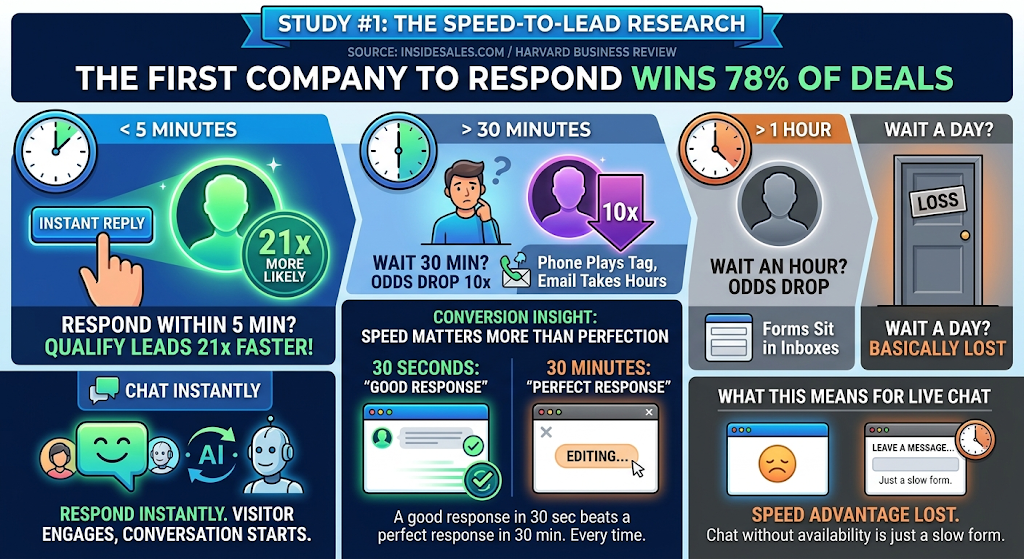
What this means for live chat:
Live chat can provide a very fast response channel. A visitor lands, a conversation can begin, and questions can potentially be addressed while the visitor is still actively considering the offer.
Email can involve delays. Phone conversations may require callbacks. Forms depend on follow-up. Chat can create an opportunity for immediate interaction.
But here’s the catch: if your chat says “Leave a message and we’ll get back to you,” much of that speed advantage disappears. The research supports fast response, not simply installing a chat widget.
The conversion insight:
Faster responses can help businesses engage prospects while their interest is still active. Live chat is one way to provide that responsiveness.
Study #2: The Forrester ROI Analysis
Source: Forrester Research
Finding: Forrester research and commissioned economic-impact studies have reported positive returns from some live-chat and digital customer-engagement implementations.
The important point isn’t that every business receives the same fixed return. ROI varies significantly depending on traffic, implementation, staffing, sales process, customer value, and the technology being used.
Potential economic benefits can come from areas such as:
- Additional conversions
- Opportunities to increase order or deal value
- More efficient customer support
- Faster responses and reduced friction
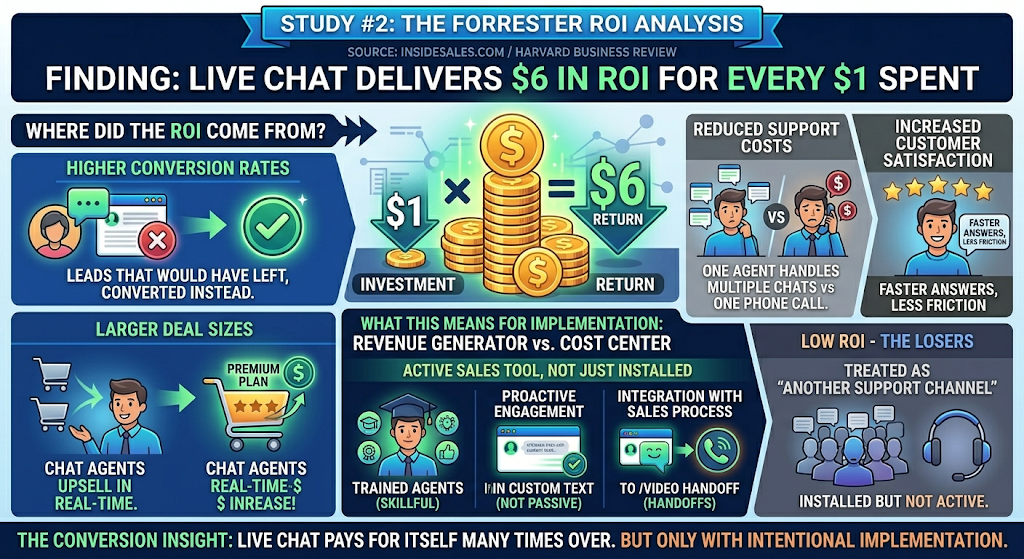
What this means for implementation:
Live chat shouldn’t automatically be viewed as either a cost center or a guaranteed revenue generator. Its value depends on how effectively it is implemented and used.
Factors that can influence performance include:
- Well-trained agents
- Relevant proactive engagement
- Integration with the sales process
- Effective chat-to-human or chat-to-call handoffs
Businesses should measure the actual impact against their own baseline rather than assuming a fixed ROI.
The conversion insight:
Live chat can generate measurable business value, but the return depends on implementation and the underlying business.
Study #3: The Ecommerce Conversion Research
Source: Ecommerce and live-chat industry research
Finding: Multiple industry reports have found that customers who engage with live chat can show higher conversion rates and order values than visitors who don’t.
That relationship is worth paying attention to, but it doesn’t necessarily mean chat alone caused the difference. Visitors who initiate chat may already have stronger purchase intent than visitors who browse silently.
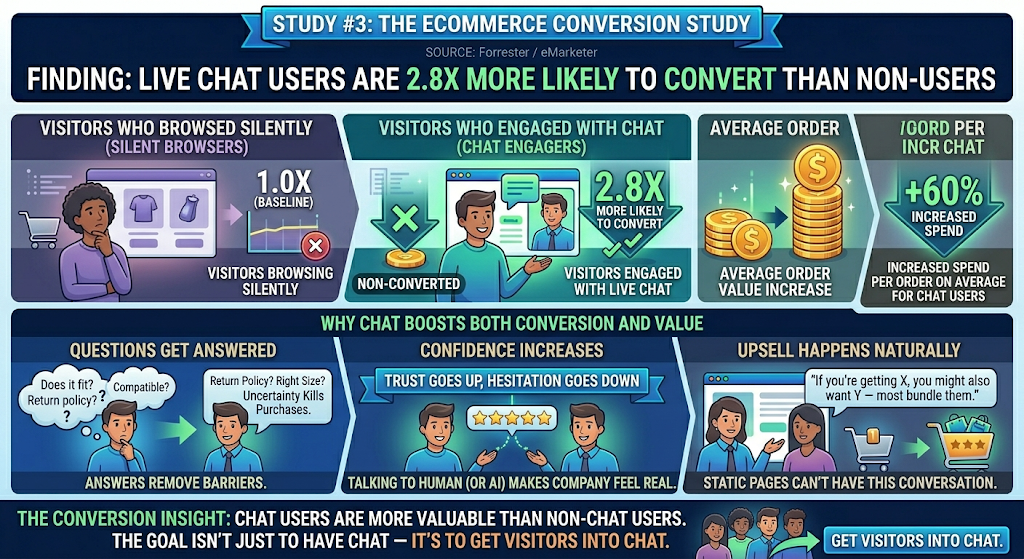
Why might chat support conversion and order value?
Three possible reasons:
- Questions get answered. Uncertainty can prevent purchases. “Does this work with X?” “What’s the return policy?” “Is this the right size?” Useful answers can remove barriers.
- Confidence can increase. Having access to responsive support can provide reassurance when a visitor has questions or concerns.
- Relevant recommendations become possible. A conversation can help customers understand complementary products or options when those recommendations genuinely fit their needs.
The conversion insight:
Chat engagement can be a useful signal of purchase intent, and helpful conversations may support customers as they make decisions.
Study #4: Proactive vs. Reactive Chat
Source: Live-chat and customer-engagement industry research
Finding: Proactive chat can increase engagement compared with relying entirely on visitors to initiate conversations.
Reactive chat waits. The visitor has to click, initiate, and ask.
Proactive chat reaches out when configured conditions are met. The system can identify the right moment and starts the conversation.
The effectiveness of that approach depends heavily on timing, targeting, and the relevance of the message.
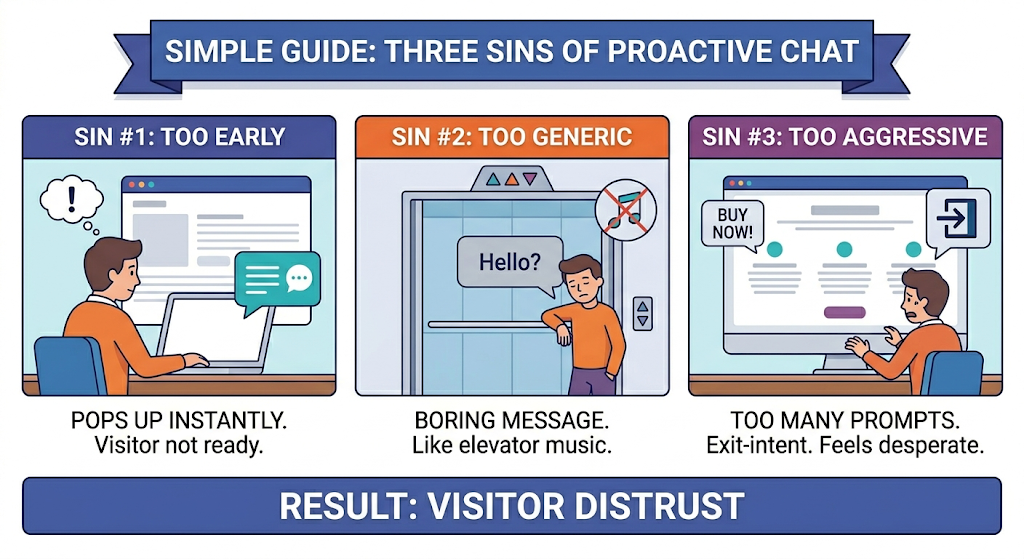
But there’s a caveat:
Proactive chat works best when it is useful rather than intrusive. Generic “Hi! How can I help?” pop-ups can easily be ignored or become annoying.
Contextual proactive chat, such as offering help while someone is comparing plans, can make the interaction more relevant to what the visitor is doing.
The conversion insight:
Proactive engagement can create more opportunities for conversation, particularly when messages are contextual and appropriately timed.
Study #5: Customer Satisfaction Research
Source: Zendesk customer-experience research
Finding: Live chat has historically received strong customer-satisfaction ratings compared with several other support channels.
Customer preferences vary by audience, industry, and situation, and historical satisfaction figures shouldn’t automatically be treated as current universal benchmarks.
| Channel | Satisfaction Rate |
| Live Chat | 92% |
| Phone | 88% |
| 85% | |
| Social Media | 84% |
| Web Forms | 80% |
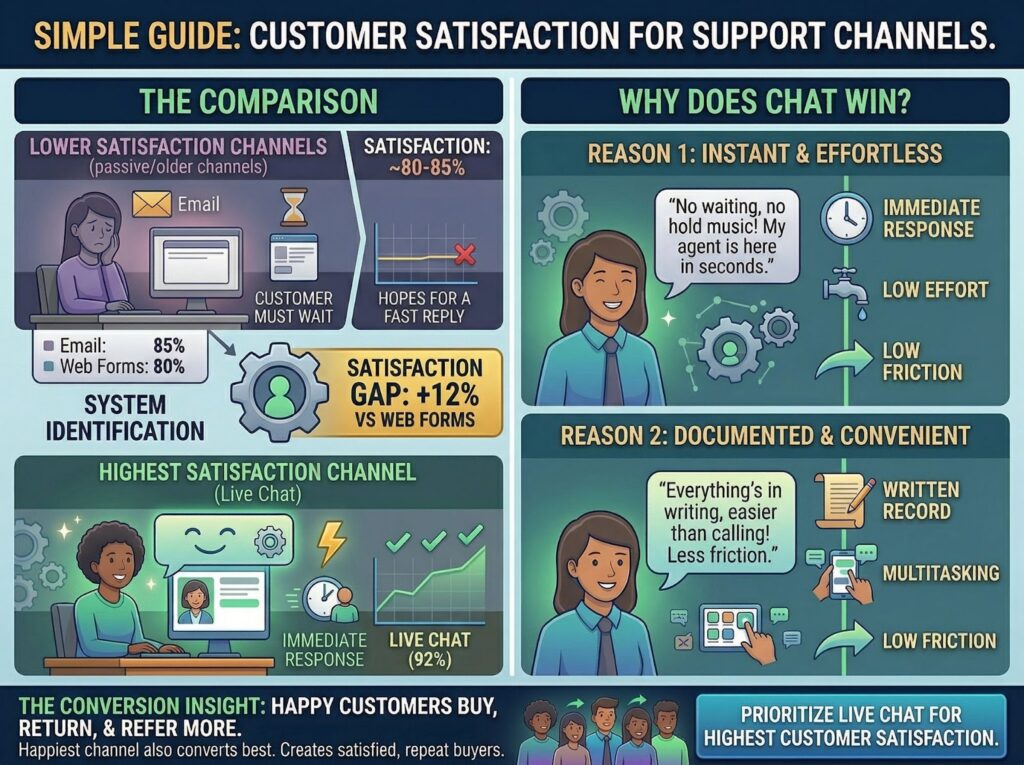
Why might customers prefer chat in some situations?
- Fast communication — Customers can potentially get help without waiting for a callback
- Multitasking — Customers can chat while doing other things
- Written record — The conversation remains in text
- Convenience — For some questions, chat may be easier than calling or emailing
What this means for conversion:
A convenient support experience can reduce friction during the buying journey. Whether that translates into higher conversion or repeat purchases depends on the quality of the interaction and the broader customer experience.
The conversion insight:
Customer satisfaction and conversion are related to many factors. Live chat can contribute by making support more accessible and responsive.
Study #6: Buyer Expectations Research
Source: Drift State of Conversational Marketing research
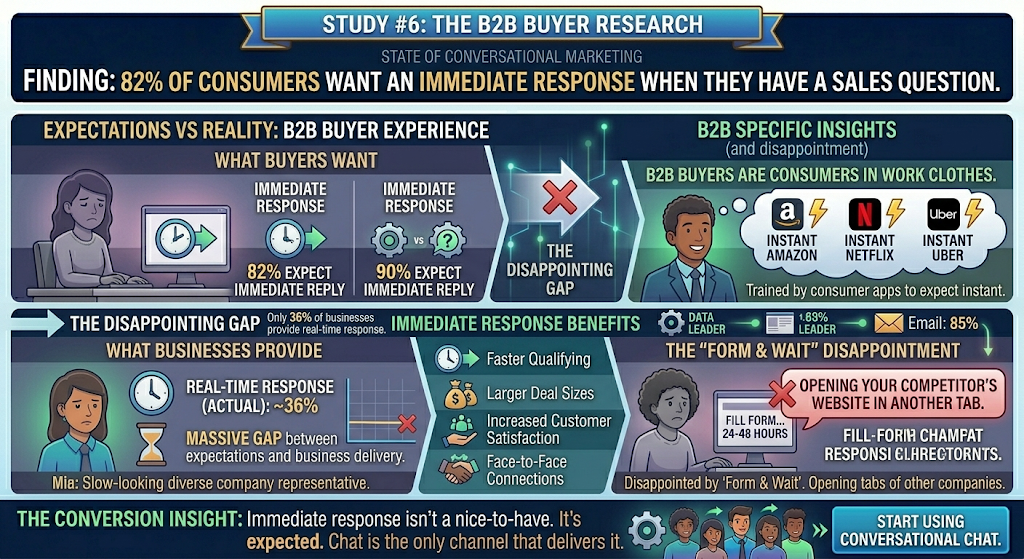
Finding: Drift’s research reported strong consumer expectations around receiving fast responses to sales and support questions.
The broader finding is that many buyers value speed when they have a question.
That creates a potential gap when a visitor wants information immediately but the only option is a form followed by a later response.
The B2B-specific insight:
B2B buyers are also consumers outside work. Experiences with fast digital services can influence what they expect from business websites.
When they hit your website and get “Fill out this form and someone will call you in 24-48 hours,” some visitors may be willing to wait. Others may continue researching alternative providers.
The conversion insight:
Fast response can improve the customer experience. Chat is one channel businesses can use to provide that response.
Study #7: Intent + Identification
Source: Visitor-identification and B2B marketing industry research
Finding: Visitor identification can give sales and marketing teams additional context about website activity and potential buying intent.
Rather than assuming a fixed conversion multiplier, the important distinction is the additional information available when a visitor can be identified.
Visitor conversion rates vary substantially depending on the website, traffic source, audience, offer, and how “identified” and “converted” are defined.
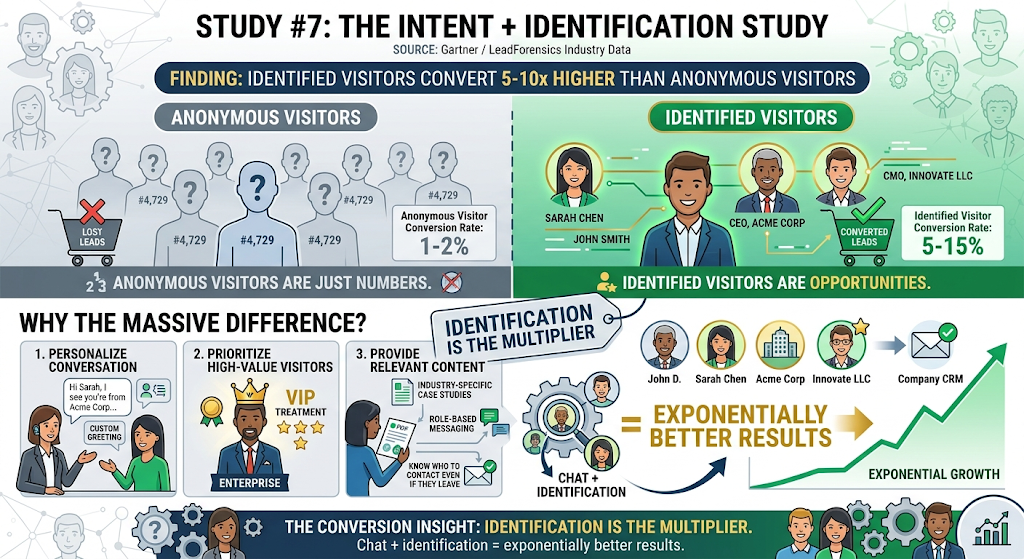
When you have relevant visitor information, you may be able to:
- Personalize the conversation using available information
- Prioritize visitors based on relevant business and intent signals
- Provide more relevant content
- Conduct appropriate follow-up where permitted
Anonymous visitors provide behavioral signals. Identified visitors can provide additional context that may help sales and marketing teams decide how to respond.
The chat connection:
Many chat tools begin with little information about the person on the other side.
When visitor identification is available, conversations can potentially include more context. That can help teams make engagement more relevant.
The conversion insight:
Identification provides context. How much that context improves results depends on how accurately and responsibly the information is used.
What The Studies Actually Prove
Let’s synthesize what the data suggests.
Live chat can support conversion. Research around response speed, customer expectations, engagement, and conversational support provides reasons to test live chat as part of a conversion strategy.
But not all chat is equal. Reactive, generic, or poorly staffed chat may perform differently from proactive, contextual, and consistently available engagement.
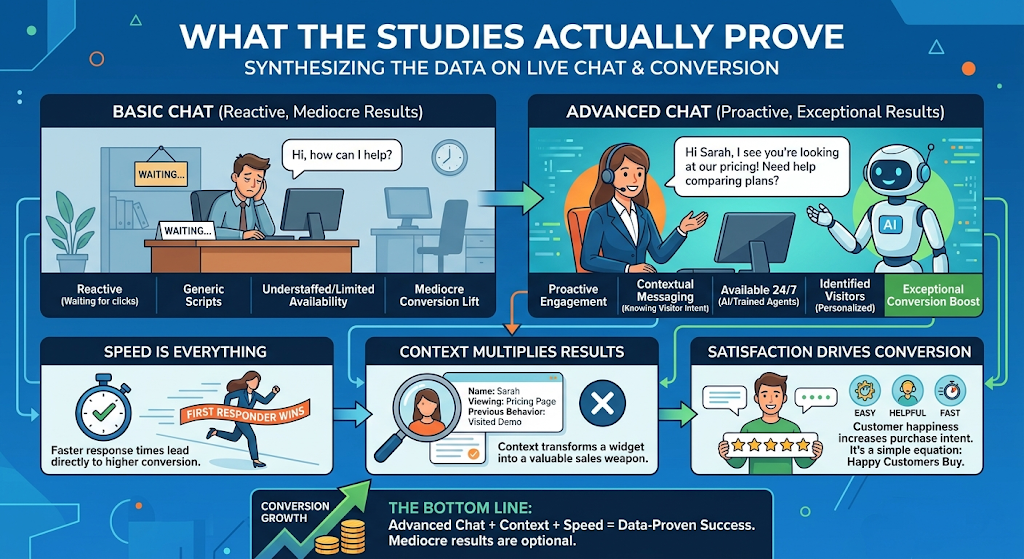
Speed matters. Responding while a prospect’s interest is active can create an advantage. Chat can help businesses respond quickly when it is actually available.
Context can improve relevance. Knowing what visitors are looking at and how they’re interacting with the website can help create more useful conversations.
Customer experience matters. Convenient, responsive communication can reduce friction, but chat is only one part of the overall buying experience.
The Gap Most Companies Miss
Here’s what’s interesting.
Many companies understand the potential value of live chat but may not be using it to its full potential.
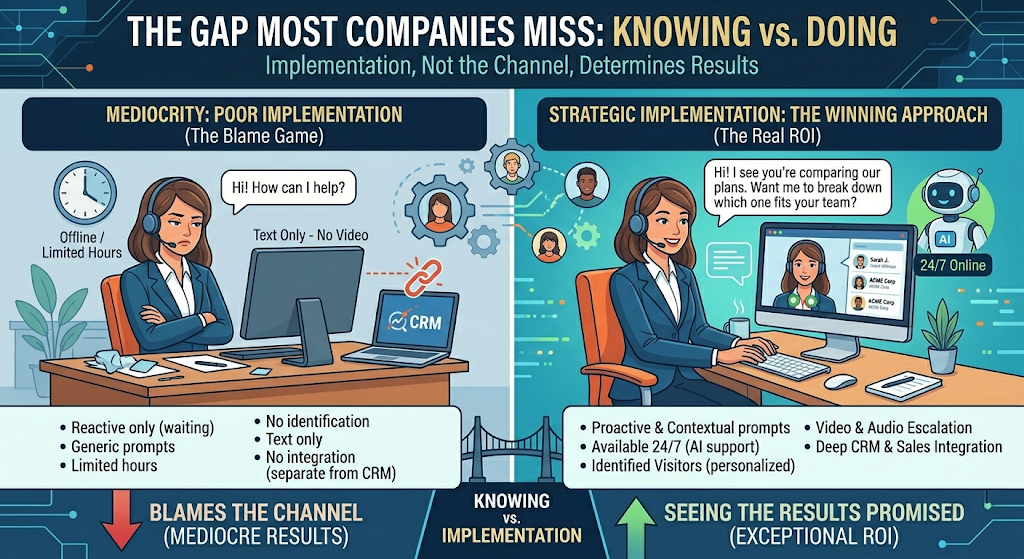
Common implementation limitations can include:
- Reactive only (waiting for visitors to start)
- Generic prompts (“Hi! How can I help?”)
- Limited availability
- Limited visitor context
- Text-only communication with no escalation option
- Chat data disconnected from the CRM or sales process
A company can install chat and still see limited results if visitors don’t use it or conversations aren’t connected to the broader customer journey.
The channel alone isn’t enough. Implementation matters.
What Effective Chat Can Include
Based on these findings, useful capabilities can include:
1. Fast response (Study #1) AI that engages immediately, 24/7, where appropriate, can help reduce response delays.
2. Proactive engagement (Study #4) Reach out at relevant moments with messages connected to visitor behavior rather than relying entirely on visitors to initiate.
3. Visitor identification (Study #7) Use available visitor information to add context and help prioritize engagement.
4. Contextual messaging (Studies #3, #4) Reference relevant behavior or page context to make conversations more useful.
5. Human and video escalation When a visitor wants more direct interaction, go face-to-face. One click. No scheduling.
6. CRM integration (Study #2) Connect conversation and lead information with the sales process so teams have the context they need.
Together, these capabilities can create a more complete customer-engagement system than a basic standalone chat widget.
Why Knock Knock Exists
We built Knock Knock around the idea that website conversations can be more useful when they’re supported by context, automation, visitor intelligence, and access to humans.
Basic chat can provide a way to communicate. More advanced engagement can add additional context and capabilities.
Knock Knock includes:
- Visitor identification — Available name, company, email, and LinkedIn information where identifiable.
- Behavior tracking — Page activity, every scroll, real-time intent scoring.
- Contextual AI — Messages informed by visitor context and configured information.
- Proactive engagement — Trigger-based outreach based on configured conditions.
- Live video — One-click access to face-to-face communication when available.
- CRM sync — Native integration with GoHighLevel, HubSpot, with additional integrations depending on your setup.
The goal is to bring these capabilities together in one platform.
The Choice
The research gives businesses good reasons to test live chat and conversational engagement.
It also shows why implementation matters.
The same channel can produce different results depending on audience, traffic quality, response speed, messaging, availability, context, and sales process.
You can install basic chat and measure how visitors respond.
Or you can test a more proactive, contextual, identified, instant, and integrated approach and compare the results against your existing baseline.
The data gives you a starting point. Your own performance data tells you what works for your business.
See The Difference
We’re running a free webinar where we show exactly what high-converting chat looks like.
You’ll see:
- Visitor identification in real-time
- Proactive, contextual engagement
- AI that actually converts
- One-click video escalation
- The full flow from visitor to customer
[Register for the Free Webinar →]
The studies prove it works. Now come see it work.
Written by Anna Hyatt, Co-Founder of Knock Knock App.
Frequently Asked Questions
Are these studies still relevant in 2026? Some of the research cited in this article is historical rather than 2026-specific. The findings can still provide useful context around response speed, customer expectations, and conversational engagement, but current performance should be evaluated using your own audience and business data.
My industry is different. Do these studies apply? The research and industry findings cover different audiences and use cases, so results shouldn’t be assumed to apply equally to every business. The most reliable approach is to test conversational engagement against your existing baseline and measure the results.
What if I don’t have budget for advanced chat tools? Start with what you have. Improve response times, experiment with relevant proactive triggers, train your team, and measure engagement. Add additional capabilities when they make sense for your business.
How do I convince my team/boss that chat is worth investing in? Use relevant research as supporting evidence, but combine it with your own data. Response times, missed website inquiries, visitor engagement, lead volume, and conversion performance can help determine whether live chat is worth testing for your business.
What’s the minimum I need to see results? There isn’t a universal minimum setup that guarantees results. Fast responses, relevant engagement, useful conversations, and integration with your existing sales process are reasonable areas to focus on when testing chat.
How quickly will I see improvement? There is no universal timeline. Engagement and conversion changes depend on traffic volume, audience, implementation, offer, and how quickly you collect enough data to evaluate performance. Establish a baseline before implementation and compare results over an appropriate testing period.
Is AI chat as good as human chat? It depends on the conversation. AI can be useful for immediate responses, routine questions, qualification, and information gathering. Human involvement can be valuable for complex questions, sensitive situations, negotiation, or conversations where judgment and personal interaction matter.

Anna Hyatt
Co-Founder | Knock Knock App
AI × Human Touch = Happier Clients, More Revenue
LinkedIn Profile


