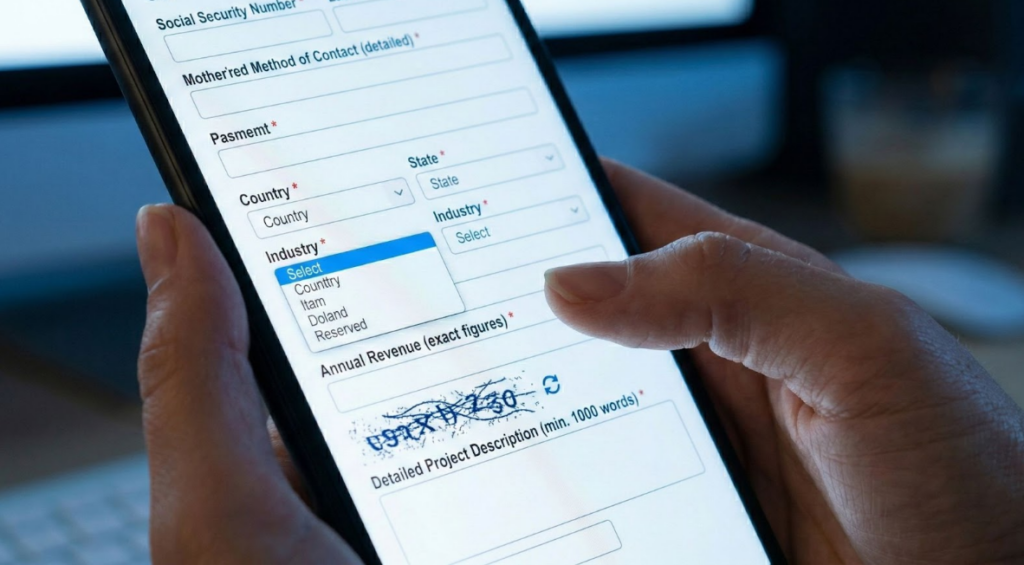
I still remember the moment that changed everything.
I was checking my form submissions and saw something that felt like a punch in the stomach.
A half-filled form.
Name filled. Company filled. Phone number filled.
And then nothing.
They stopped right before hitting Submit.
You don’t start a form unless you’re interested. You don’t fill half your details unless you’re seriously considering talking to someone.
A half-filled form is the digital version of someone standing at your shop counter and walking away without saying a word.
That helplessness pushed me to build Knock Knock. But the real lesson wasn’t about forms.
It was about timing.
The Industry Has It Backwards
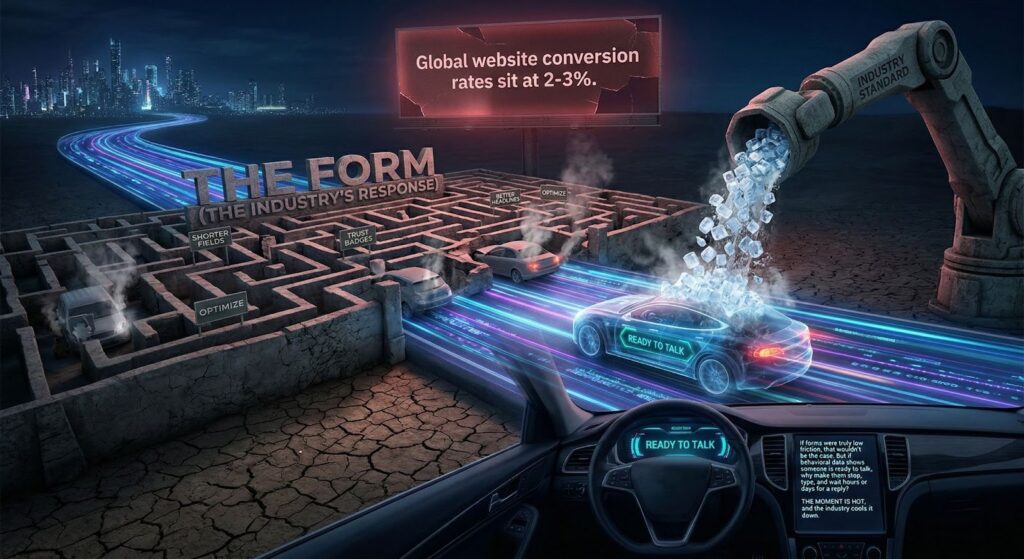
Global website conversion rates sit at 2-3%.
If forms were truly low friction, that wouldn’t be the case. Yet the industry’s response is always the same: optimize the form. Better headlines. Shorter fields. Trust badges.
But here’s the truth.
If behavioral data already shows someone is ready to talk, why make them stop, type, and wait hours or days for a reply?
The moment is hot, and the industry cools it down.
Forms Protect Companies, Not Buyers
Here’s what most people won’t admit: forms aren’t there to help the buyer.
They’re there to batch inquiries, to let sales respond on their schedule, to avoid having someone available right now.
A form quietly says: We’re not ready. Your urgency doesn’t matter. We’ll get to you when we feel like it.
Changing a form is comfortable. Removing it is scary.
Most companies keep blaming form design because it’s the only part they feel allowed to touch. Tweaking headlines keeps the old process intact.
But removing the form at the hottest moment? That forces them to rethink their whole sales workflow.
Forms protect companies from effort. Conversations require effort.
A form lets them delay. A conversation demands presence.
Even though the data clearly shows the drop-off, companies stay loyal to the form because it feels efficient.
Even though it bleeds revenue.
The Shelf Life of Intent Is Minutes, Not Days
When I finally built the system to catch people in real time, the truth hit me.
Buyer intent has the shelf life of warm bread.
The hottest intent window is 3-7 minutes. That’s when they’re comparing, scrolling slowly, re-reading, looking for a reason to say yes.
They’re mentally already with you.
After 10 minutes, you’re already cooling down. Not because they’re not interested. Because life happens.
Slack pings. A child calls. Their boss walks in. A new tab opens.
They think: I’ll do this later.
Later almost always means never.
After 24 hours, they’re comparing competitors. And if a competitor reached out first, you’re already forgotten.
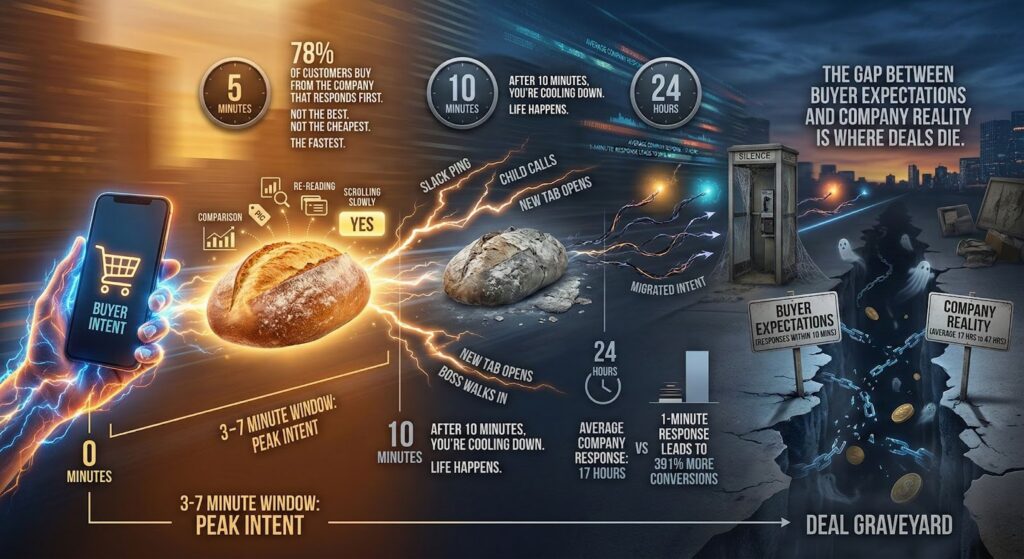
The buyer’s intent didn’t expire. It migrated to whoever showed up.
Research backs this up. 78% of customers buy from the company that responds first. Not the best company. Not the cheapest. The fastest.
After just 5 minutes, conversion rates drop by 8X. A 1-minute response time can lead to 391% more conversions.
But the average response time for web leads is 17 hours. Some companies take 47 hours. Almost two full days of silence after a lead shows interest.
And 82% of consumers expect responses within 10 minutes.
The gap between buyer expectations and company reality is where deals die.
You’re Optimizing the Wrong Moment
If you’re still A/B testing button colors and polishing form copy, you’re polishing a gate your buyers don’t want to walk through.
Conversion doesn’t live on your form.
It lives in the three to seven minutes before they ever see it. When intent is hot, curiosity is alive, and they’re ready to talk.
No headline, no button color, no trust badge can resurrect intent that has already cooled.
Your buyer doesn’t need a better form.
They need you. Right when they’re ready, not a day later.
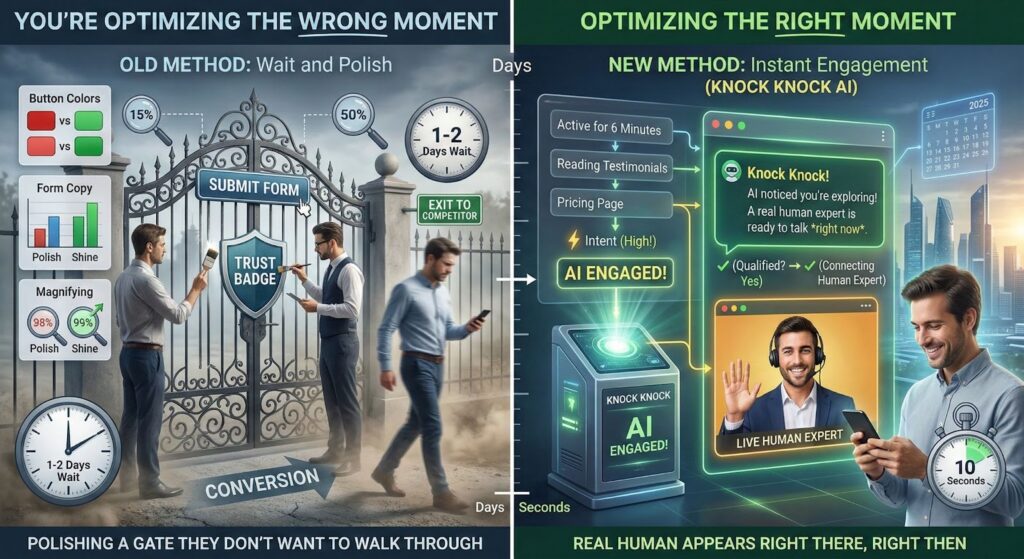
Forms wait. Buyers don’t.
That’s why I built Knock Knock. AI notices when someone is ready. AI engages them instantly. AI qualifies them in seconds.
And a real human appears right there, right then. Before the moment cools.
No company can afford to make people wait. Not in 2025. Not when attention evaporates and alternatives are one click away.
And definitely not when the buyer has already shown you they’re ready right now.
Frequently Asked Questions
What’s the best alternative to forms on a website? The best alternative is real-time visitor engagement that captures leads while intent is hot, not after it cools. Knock Knock does exactly this. It identifies visitors the moment they arrive (name, company, email, social profiles), detects buying behaviour in real-time, engages proactively with AI before they ever reach a form, qualifies them instantly, and connects hot leads to humans via live video, voice, or chat. No waiting. No friction. No half-filled forms abandoned. The visitor gets immediate help. You get a qualified lead with full context. That’s what replaces forms: presence, not paperwork.
Should I remove all forms from my website? Not necessarily. Forms still have their place for specific use cases like newsletter signups or support tickets. But for high-intent moments, when someone is actively considering your service, forms create friction that kills deals. Replace forms with real-time engagement where intent is hottest.
What’s the ideal response time for a lead? Under 5 minutes. Ideally, instant. Research shows conversion rates drop 8X after just 5 minutes. A 1-minute response time can deliver 391% more conversions. The goal isn’t “fast enough.” The goal is “while they’re still on your website.”
How do I know when someone is ready to talk? Behaviour tells you everything. Time on pricing page. Multiple page views. Return visits. Slow scrolling through key sections. AI can detect these signals in real-time and engage at exactly the right moment, before they ever reach a form.
What if I can’t have someone available 24/7? That’s exactly what AI solves. AI engages visitors instantly, qualifies them, and captures their information around the clock. When you’re available, you take over. When you’re not, AI ensures no hot lead goes cold waiting for a response.
Won’t instant engagement feel pushy or intrusive? Only if done wrong. A generic popup is intrusive. A relevant message based on what they’re viewing is helpful. “I see you’re looking at our pricing. Want me to walk you through the options?” feels like service, not a sales pitch.
What happens to the leads who aren’t ready to talk immediately? AI captures their information and intent data. They go into your CRM with full context. You can nurture them on your timeline. But the difference is you have their details, you know what they were interested in, and you can follow up proactively instead of waiting for a form submission that may never come.
How does this work with my existing CRM and sales process? Knock Knock integrates with GoHighLevel, HubSpot, and other CRMs via Zapier. Leads flow automatically with full context: who they are, what they viewed, what questions they asked, their intent score. Your sales process gets better inputs, not a replacement.
What results can I realistically expect? Businesses using real-time engagement instead of forms typically see 30-50% more conversions from existing traffic. Not from more visitors. From capturing the buyers who were already there but would have left a form half-filled or never filled at all.
Ready to stop losing deals to forms?
👉 Try Knock Knock: knockknockapp.ai

Anna Hyatt
Co-Founder | Knock Knock App
AI × Human Touch = Happier Clients, More Revenue
LinkedIn Profile