
You Bought the AI. It’s Not Working.
Let me guess.
You got excited about AI. You saw the demos. You thought, “This changes everything.”
You bought a chatbot. Installed it. Launched it.
And then… the results weren’t what you expected.
Awkward conversations. Confused visitors. Leads that went nowhere.
You’re thinking: “AI was supposed to be the future. Why isn’t mine working?”
One possible answer:
You automated. You didn’t orchestrate.
The Difference Nobody Explains
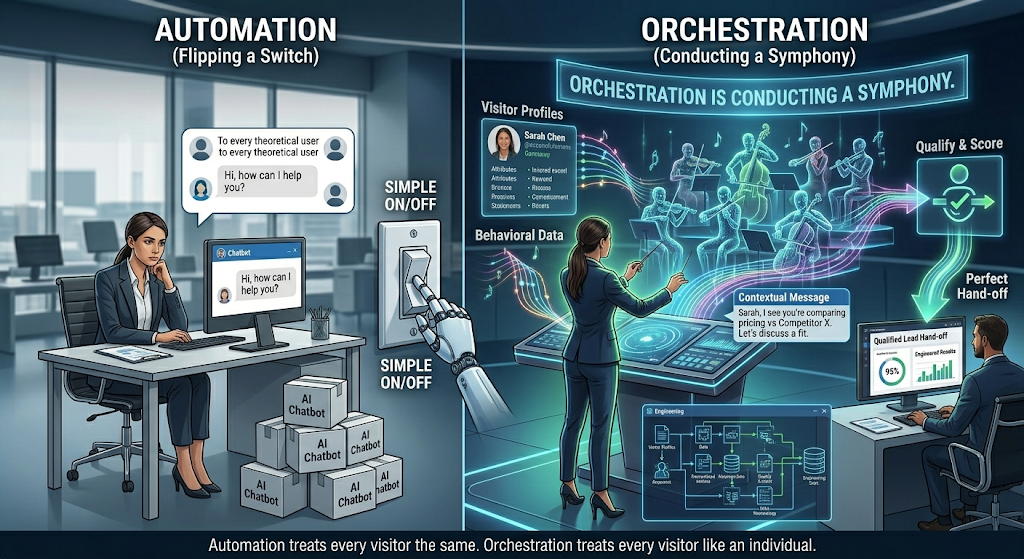
Automation: “I installed a chatbot. It says ‘Hi, how can I help you?’ to everyone.”
Orchestration: “My AI uses available visitor and behavioral context. It watches how visitors engage with the website. It engages at exactly the right moment with exactly the right message. It qualifies through conversation. It hands off to a human when the timing is right.”
Automation is flipping a switch.
Orchestration is conducting a symphony.
One can rely on the same experience for every visitor. The other uses available context to create more relevant interactions.
One turns on the technology. The other designs how the technology works throughout the customer journey.
The Cookie Cutter Problem
I see this constantly.
A business owner buys a chatbot. Default settings. Maybe customizes the greeting.
The chatbot says the same thing to everyone:
“Hi! Welcome to [Business Name]. How can I help you today?”
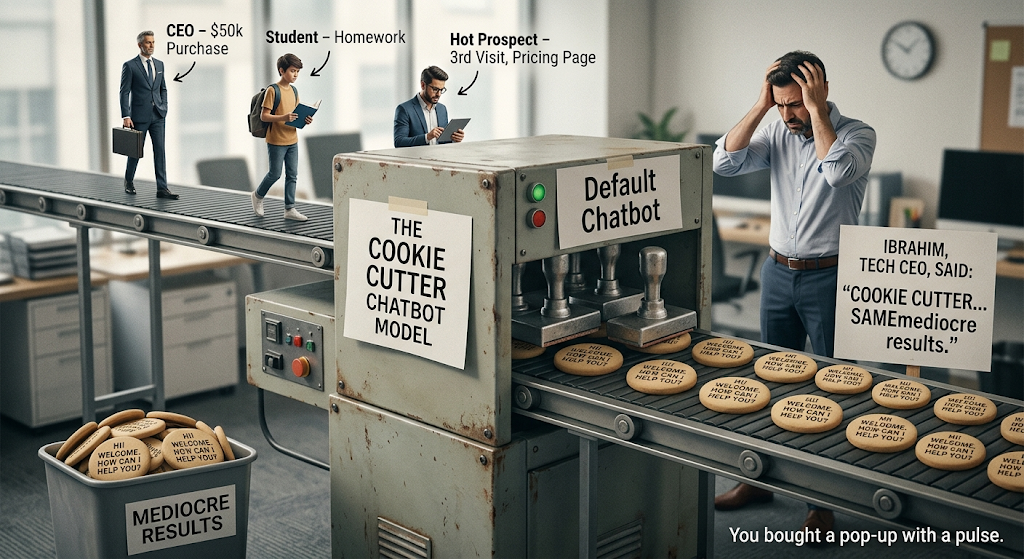
Every. Single. Visitor.
The CEO evaluating a major purchase? “Hi! How can I help you today?”
A student doing homework? “Hi! How can I help you today?”
A prospect who’s visited three times and just spent four minutes on pricing? “Hi! How can I help you today?”
Same message. Same energy. Very little context.
That’s the cookie-cutter problem.
Same shape. Same output. Similar experience for everyone.
You didn’t necessarily build an intelligent customer journey. You added another pop-up to the website.
What Orchestration Actually Looks Like
Let me show you.
Imagine Marcus lands on your website. He’s an Operations Director at a mid-size manufacturing company.
Using the visitor information and behavioral signals available to your system, it may know:
- His available profile or company information
- The traffic source or campaign that brought him to the website
- Whether he’s a returning visitor
- What pages or content he’s previously explored
The AI watches him browse.
Features page. Then the integrations page.
The system evaluates the available signals.
Returning visitor. Relevant company. Deeper engagement. Intent signals increasing.
The AI engages.
Not simply:
“Hi! How can I help?”
Instead, the conversation can reflect the context available from his current journey:
“I see you’re looking at our integrations. Are you evaluating us for a specific setup?”
Marcus pauses. That’s specific. That’s relevant.
He responds: “Yeah, running SAP. Wondering about compatibility.”
The AI answers using the knowledge and information it has been configured to access.
It can provide relevant information about integration capabilities and answer appropriate follow-up questions.
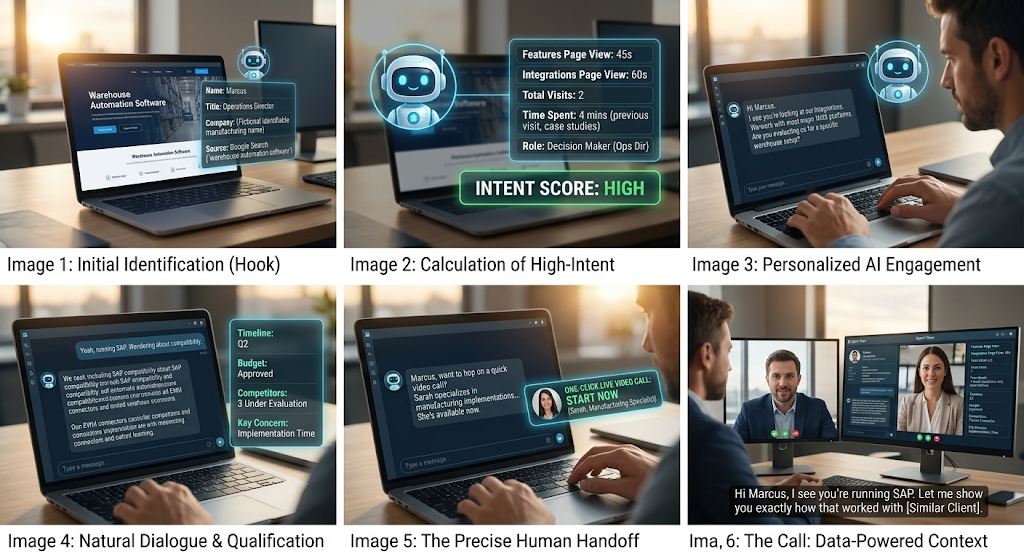
The AI qualifies.
Through conversation, it can gather information such as Marcus’s requirements, timeline, priorities, and implementation concerns.
The AI recognizes when human involvement may be useful.
“Marcus, want to hop on a quick video call? A member of our team can walk you through how this could work with your setup.”
One click. Live video. Face-to-face.
The sales representative joins with relevant context.
Depending on the information captured and shared through the system, the representative can review available visitor information, website activity, conversation history, and qualification details.
Instead of starting completely from scratch, the conversation can continue from the context already gathered.
That’s orchestration.
Each step is designed to connect visitor intelligence, AI engagement, qualification, and human interaction into a more coordinated experience.
That’s not simply turning on a chatbot. That’s building a system.
The Skill Gap That’s Coming
Here’s what happens as AI adoption continues.
AI tools become commoditized. More businesses gain access to increasingly capable AI models and tools.
Access to AI alone may become less of a differentiator.
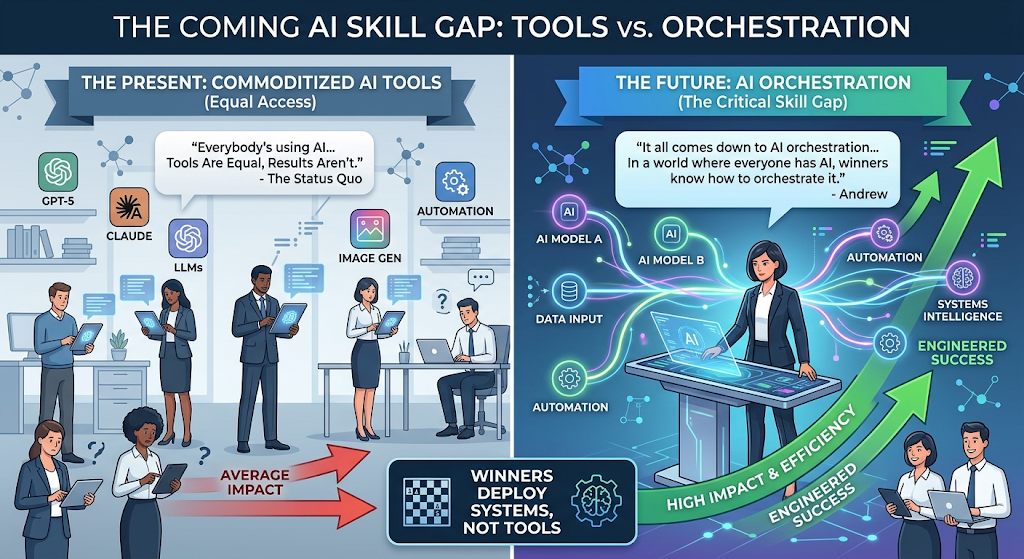
The way businesses deploy and connect those tools can become increasingly important.
In a world where more businesses have AI, the difference can come down to how effectively they orchestrate it.
Not necessarily the fanciest tools. Better-connected systems.
Not simply more money spent. More thought applied to implementation.
AI orchestration is becoming an increasingly important skill.
The Question You Need to Answer
Be honest with yourself:
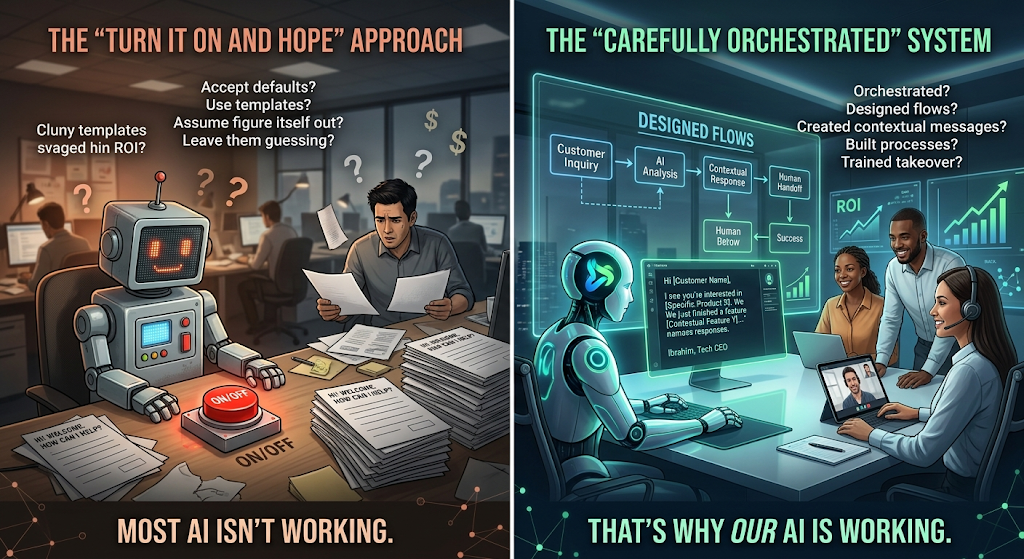
Is my AI orchestrated? Or did I just turn it on and hope?
Did you design the flows? Or accept the defaults?
Did you create contextual messages? Or use templates?
Did you build handoff processes? Or assume the system would handle everything?
Did you train your team on takeover? Or leave them guessing?
If your AI isn’t producing the results you expected, these are useful questions to ask.
The issue may not always be the AI itself. It may be how the system has been configured, connected, and integrated into your sales process.
The Difference in Results
Basic AI automation may look like:
- Same message to everyone
- Limited visitor context
- Limited behavior tracking
- No intent scoring
- Generic engagement
- Form-based handoffs
- Disconnected from the sales team
AI orchestration can include:
- Contextual messages based on available behavior
- Visitor or company intelligence where available
- Real-time behavior tracking
- Intent scoring to prioritize hot leads
- Engagement based on relevant buying signals
- Handoff to live video when appropriate
- Sales teams receiving useful context
The underlying AI technology may be similar. The deployment can be very different.
The difference isn’t necessarily the model. It’s how the technology is implemented across the customer journey.
The Future Is AI-to-AI
One more thing.
As AI agents become more capable, websites may increasingly receive interactions initiated or assisted by AI systems acting on behalf of people.
That creates the possibility of two types of website interactions:
- Humans
- AI agents researching or completing tasks on behalf of humans
For example, an AI agent could potentially be asked to research products, compare providers, gather pricing information, or help someone evaluate different options.
That means businesses may increasingly need to think about how their digital systems communicate not only with people, but also with AI-powered tools and agents.
Orchestration isn’t just about engaging humans. It’s also about preparing systems for a digital environment where AI agents may play a larger role in how people research and make decisions.
See Orchestration in Action
We built Knock Knock around the idea that simply adding AI to a website isn’t enough.
The way AI is configured, connected, and integrated with human interaction matters.
We built a system that orchestrates the entire flow:
- Identify visitors using available visitor intelligence
- Track behavior in real-time
- Score intent automatically
- Engage contextually based on relevant signals
- Qualify through AI-powered conversation
- Hand off to live video with useful context
It’s more than a standalone chatbot. It’s designed to connect different parts of the website engagement process.
We’re showing how it works in a free 30-minute webinar.
Not just slides and theory. A live demonstration.
You’ll see how AI orchestration can work in practice, how the different parts of the system connect, and what to consider when building a more coordinated AI-powered customer journey.

Anna Hyatt
Co-Founder | Knock Knock App
AI × Human Touch = Happier Clients, More Revenue
LinkedIn Profile


